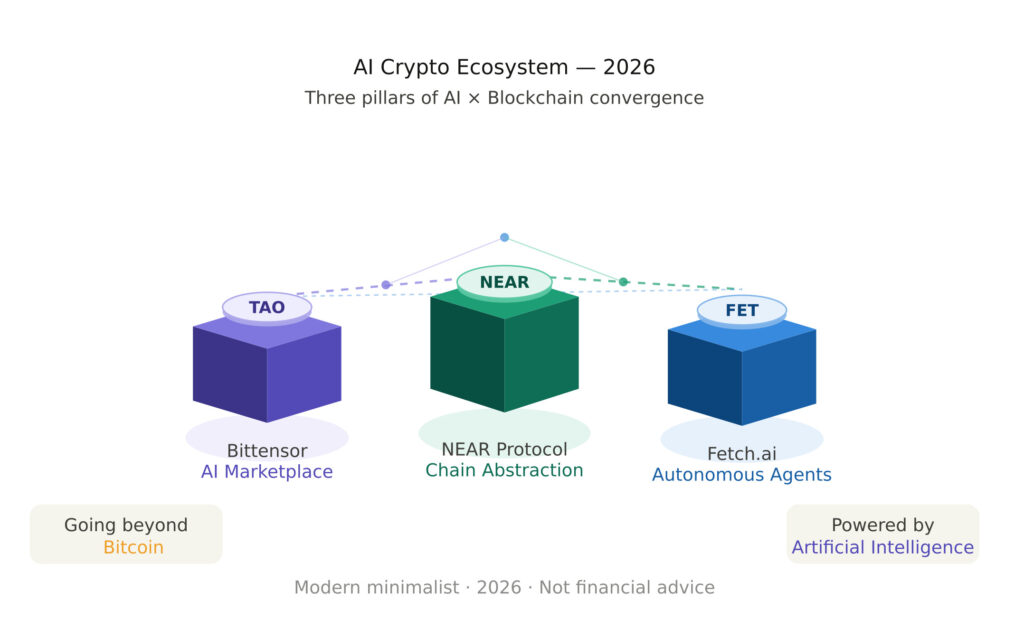
AI crypto coins 2026 have officially moved from niche developer chatter to mainstream investor conversation — and if Bitcoin is the only crypto on your radar right now, you are genuinely missing one of the most exciting technological shifts of the decade. This guide is your complete, beginner-friendly breakdown of the three most compelling AI crypto coins 2026 has to offer: Bit tensor (TAO), NEAR Protocol (NEAR), and Fetch.ai (FET). We’ll cover exactly what they do, how they differ from each other, why they matter, and what you need to know before putting a single rupee — or dollar — into any of them.
What Are AI Crypto Coins? 2026’s Hottest Investment Category Explained
Let’s be real — the phrase “AI crypto coins” sounds like someone threw two buzzwords in a blender and hit smoothie. But stick with it for a moment, because what’s happening at the intersection of artificial intelligence and blockchain technology in 2026 is genuinely one of the most exciting developments in both worlds.
The term describes a fast-growing category of blockchain projects, and understanding what qualifies as one of the top AI crypto coins 2026 has produced is the first step to investing wisely.
AI crypto coins are cryptocurrencies whose underlying blockchain networks are specifically designed to power, govern, or incentivise artificial intelligence workloads. We’re not talking about tokens that slap “AI” on their marketing page and call it a day. We mean coins where the entire architecture — the consensus mechanism, the tokenomics, the governance model — revolves around AI computation, AI model trading, or AI-powered automation.
Think of it this way: Bitcoin was built to be decentralised money. Ethereum was built to be decentralised computing. AI crypto coins like TAO, NEAR, and FET are being built to be decentralised intelligence.
The global AI market is expanding at a remarkable pace in 2026, and blockchain’s unique properties — transparency, permissionlessness, immutability — make it a surprisingly natural fit for AI systems that need to share models, verify outputs, and coordinate without trusting a single central authority.
Why AI Crypto Coins 2026 Are Booming: The Perfect Storm
The rise of AI crypto coins 2026 is not accidental — it is the result of three converging forces: the centralization crisis in AI, the explosion of autonomous agent technology, and the maturation of blockchain infrastructure.
There’s a perfect storm brewing, and it’s worth understanding why AI crypto coins are capturing so much attention right now rather than two years ago.
First, the centralisation problem of AI has become impossible to ignore. In 2026, a handful of companies control the most powerful AI models in existence. This centralisation raises real concerns: who controls the training data, who decides what the AI can and cannot do, and who profits. Blockchain offers a credible alternative — a world where AI models are publicly trained, openly accessible, and economically incentivised through tokens.
Second, the computational demands of AI are growing beyond what traditional cloud infrastructure can comfortably accommodate at scale. Distributed computing networks — like the ones that TAO and FET are building — can theoretically tap into idle GPU power around the world, making AI training and inference dramatically cheaper and more accessible.
Third, the concept of AI agents — autonomous software programs that can browse the web, make decisions, execute transactions, and interact with other AI systems on your behalf — has leapt from science fiction to practical reality. These agents need economic rails. They need ways to pay for services, get paid for tasks, and coordinate without human intervention at every step. That’s exactly what crypto infrastructure provides.
So when we talk about AI crypto coins in 2026, we’re not talking about speculation-driven hype coins. We’re talking about infrastructure layers for the next generation of the internet.
Bittensor (TAO) — The AI Crypto Coin 2026 Investors Are Watching
Of all the AI crypto coins 2026 has brought into focus, Bit tensor’s TAO is arguably the most intellectually radical — and the most misunderstood.
Launched by Jacob Steeves and Ala Shaabana, Bittensor describes itself as a decentralised machine learning network. But that clinical description doesn’t quite capture how wild and interesting this project actually is.
How Bittensor Works
Here’s the core idea: imagine a marketplace where AI models — not NFTs, not meme coins, but actual machine learning models — can be uploaded, evaluated, and rewarded based on their performance. Bittensor uses a unique consensus mechanism called Proof of Intelligence, where validators assess the quality of AI model outputs, and miners (who run the models) are rewarded in TAO tokens proportional to how useful their models are.
The network is organised into subnets — specialised sub-networks focused on specific AI tasks. There are subnets for text generation, image recognition, financial prediction, coding assistants, and more. Each subnet has its own economics, but all flow back to the TAO token.
This is genuinely novel. Rather than rewarding miners for doing pointless cryptographic hash computations (like Bitcoin), Bittensor rewards miners for doing useful work — advancing the frontier of artificial intelligence. It’s a fundamentally different social contract.
Why TAO Is Interesting for Investors
TAO has a capped supply of 21 million tokens — intentionally mirroring Bitcoin’s scarcity model. As the number of subnets grows and more developers build on the Bittensor network, demand for TAO increases for staking, governance, and subnet registration.
In 2026, the Bittensor ecosystem has expanded significantly. Hundreds of subnets are now operational, and the developer community is vibrant. Several high-profile AI research groups have begun exploring Bittensor as a way to monetise their models directly — bypassing the traditional academic or corporate publishing model entirely.
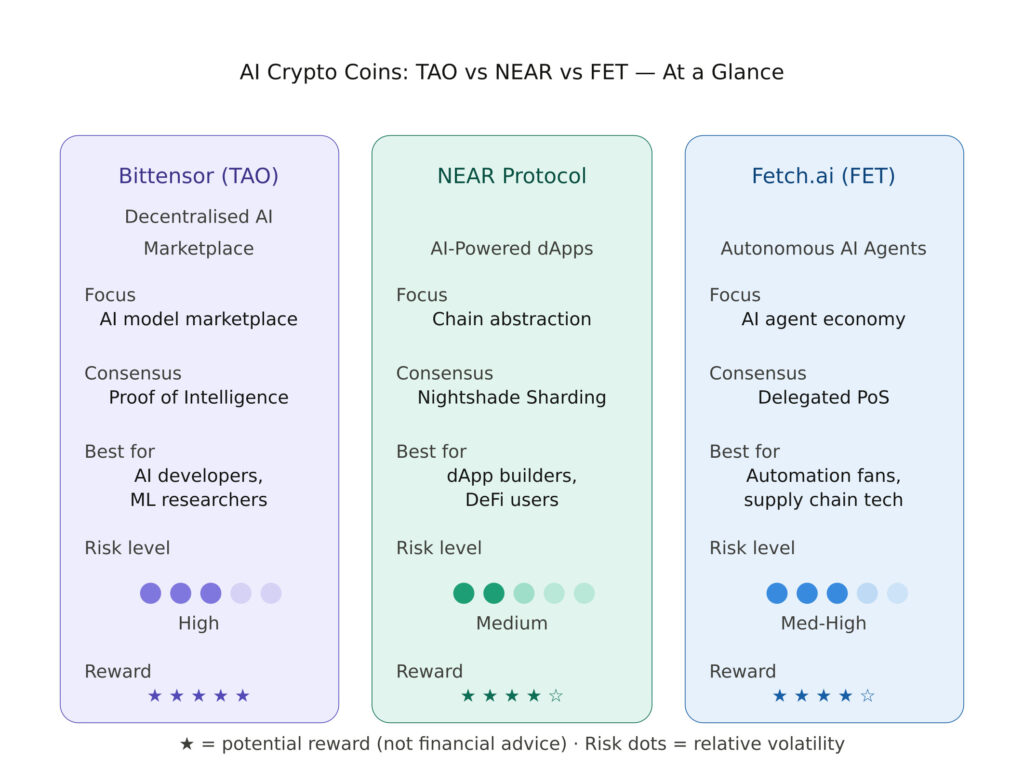
TAO is best suited for: Investors with a high risk tolerance who believe in the long-term decentralisation of AI infrastructure and want exposure to a genuinely novel blockchain use case.
Key risks: Bittensor is technically complex and less liquid than mainstream coins. Its success depends heavily on whether the AI developer community adopts it as a standard, which remains uncertain.
For investors hunting AI crypto coins 2026 with genuine technical depth and Bitcoin-style scarcity, TAO deserves serious research time.
NEAR Protocol — 2026’s Most Scalable AI Crypto Coin
NEAR Protocol is the AI crypto coins 2026 story that most mainstream investors have been slowest to discover — and that may be exactly what makes it interesting.
NEAR is a layer-1 blockchain that has been around since 2020, but its pivot toward AI integration in 2024–2026 has given it a second wind that has genuinely surprised many analysts.
The Chain Abstraction Vision
NEAR’s big idea in 2026 is chain abstraction — the notion that users and AI agents shouldn’t have to think about which blockchain they’re on. NEAR wants to be the glue that holds the multi-chain AI ecosystem together, allowing AI agents to interact with assets and applications across Ethereum, Solana, Bitcoin, and others — all through NEAR’s infrastructure.
This is not a small ambition. And NEAR’s technical foundation makes it credible. The network uses a sharding technology called Nightshade, which splits the blockchain into parallel shards that process transactions simultaneously. This gives NEAR extremely high throughput and low transaction fees — critical requirements for AI agents that might be executing hundreds of microtransactions per minute.
NEAR AI — The User-Facing Bet
In 2026, NEAR has also launched NEAR AI — an open-source AI assistant and agent platform that allows developers to build AI applications directly on the NEAR blockchain. This represents a different strategy from Bittensor: rather than building a marketplace for AI models, NEAR is building an AI application platform where the blockchain layer is largely invisible to the end user.
The user experience focus has always been a NEAR strength — it was one of the first blockchains to offer human-readable wallet addresses (like “yourname.near” instead of a 42-character hexadecimal string), and this philosophy carries into their AI products.
Why NEAR Is Interesting for Investors
NEAR occupies a sweet spot in the AI crypto coins landscape. It’s more established than many newer AI tokens, has a working product with real users, and its chain abstraction vision addresses a genuine market need.
The NEAR token is used for transaction fees, staking, and governance, giving it utility beyond pure speculation. In 2026, staking yields on NEAR have been competitive, providing a passive income component that more speculative AI coins cannot offer.
NEAR is best suited for: Investors who want AI blockchain exposure with slightly lower risk than pure-play AI tokens, and who appreciate a project with a long track record and institutional backing.
Key risks: NEAR competes in a crowded layer-1 market and must successfully execute its chain abstraction roadmap to justify a premium valuation over its competitors.
As AI crypto coins 2026 go, NEAR offers the rare combination of working infrastructure, institutional backing, and a clear AI roadmap.
Fetch.ai (FET) — The AI Crypto Coin 2026 Built for Autonomous Agents
Fetch. Ai’s FET token represents the most agent-focused entry in the AI crypto coins 2026 landscape — and its ASI Alliance backing makes it one of the most ecosystem-rich bets available.
The pitch is simple: what if software programs could act as economic agents — earning money, spending money, negotiating with other agents, and completing tasks — entirely on their own, without constant human oversight?
That’s what Fetch.ai is building.
The Autonomous Agent Economy
Fetch.ai’s platform allows developers to create AI agents — autonomous programs that can interact with external APIs, process data, make decisions using machine learning models, and transact on the blockchain using FET tokens. These agents can be deployed for an extraordinary range of use cases.
In 2026, Fetch.ai agents are being deployed in supply chain management (agents that automatically reroute shipments when disruptions are detected), decentralised finance (agents that manage yield farming positions across multiple protocols), energy markets (agents that buy and sell electricity in smart grid environments), and travel and logistics (agents that book flights, compare prices, and manage refunds autonomously).
The FET token serves as the economic fuel for this agent economy — used to pay for computation, access data services, and participate in governance. As the number of deployed agents grows, so does the demand for FET.
The ASI Alliance — FET’s Secret Weapon
In 2024, Fetch.ai merged its token with SingularityNET (AGIX) and Ocean Protocol (OCEAN) under a new umbrella called the Artificial Superintelligence Alliance (ASI Alliance). The FET token was rebranded as the ASI token in the merged ecosystem, though FET remains the widely used ticker on most exchanges as of 2026.
This merger gave Fetch.ai access to a much larger ecosystem — SingularityNET brings AI marketplace capabilities, while Ocean Protocol contributes decentralised data sharing. Combined, the ASI Alliance represents one of the most ambitious attempts to build a complete, decentralised AI economic infrastructure stack.
FET is best suited for: Investors excited about autonomous AI agents as a near-future reality, and who want exposure to a project with real enterprise partnerships and a growing ecosystem.
Key risks: The autonomous agent concept is still maturing, and real-world adoption beyond crypto-native use cases is still being proven. The ASI merger created token complexity that some investors find confusing.
TAO vs NEAR vs FET: Which AI Crypto Coin Is Right for You in 2026?
Putting all three AI crypto coins 2026 side by side reveals that each occupies a genuinely distinct lane — there is no obvious single winner.
If you’re a developer or AI researcher, TAO’s Bittensor network is the most intellectually compelling — you can literally monetise your AI models and earn TAO for contributing useful intelligence to the network.
If you’re a DeFi user or dApp enthusiast, NEAR Protocol’s combination of high throughput, low fees, and chain abstraction makes it a practical choice with real ecosystem depth and institutional credibility.
If you’re excited about the “autonomous agent” future, Fetch.ai’s FET token with the ASI Alliance backing gives you exposure to what might become the economic infrastructure of AI agents — a market that doesn’t really exist yet at scale but could be enormous.
For most retail investors, a diversified approach — holding a basket of AI crypto coins rather than concentrating in one — is a more sensible strategy than trying to pick the single winner in what is still a rapidly evolving space.
How to Invest in AI Crypto Coins in 2026 Safely: A Beginner’s Roadmap
Approaching AI crypto coins 2026 with a disciplined investment strategy is far more important than trying to time the market perfectly.
Ready to move beyond Bitcoin? Here’s a practical, beginner-friendly approach to investing in AI crypto coins like TAO, NEAR, and FET in 2026.
Step 1: Start with Research
The fact that you’re reading a detailed explainer rather than buying a coin because someone on social media told you to is already a great sign. AI crypto coins have genuine technical complexity, and understanding what you own — at least at a conceptual level — dramatically reduces the likelihood of panic-selling during a market downturn.
Step 2: Choose a Reputable Exchange
TAO, NEAR, and FET are all available on major centralised exchanges in 2026. Look for exchanges with strong security records, regulatory compliance in your jurisdiction, and reasonable trading fees. For TAO specifically, check availability carefully as it has historically had lower exchange coverage than NEAR or FET.
Step 3: Consider a Dollar-Cost Averaging Strategy
Rather than investing a lump sum — which exposes you to timing risk in highly volatile markets — consider dollar-cost averaging (DCA). This means investing a fixed amount (say, a set sum each month) regardless of the current price. Over time, this smooths out your average purchase price.
Step 4: Use Cold Storage for Significant Holdings
If you’re planning to hold AI crypto coins for a year or longer, consider moving them off the exchange into a hardware wallet. This protects your holdings from exchange hacks — a very real risk that has claimed billions in investor funds historically.
Step 5: Limit AI Crypto to an Appropriate Portfolio Allocation
These are high-risk, high-potential assets. Financial advisors (note: this blog post is not financial advice — please consult a professional) typically suggest limiting speculative crypto positions to a small percentage of overall investment portfolios. Don’t invest money you cannot afford to lose entirely.
Risks of AI Crypto Coins in 2026 Every Investor Must Know
Every investor excited about AI crypto coins 2026 must spend equal time understanding the very real risks these assets carry.
We’d be doing you a disservice if we only told you the exciting parts. Here are the real risks associated with investing in AI crypto coins.
Market Volatility: All three tokens — TAO, NEAR, and FET — have experienced significant price swings in their histories. A 50–80% drawdown from peak prices is not unusual in crypto markets, even for fundamentally sound projects. Stomach of steel required.
Regulatory Uncertainty: The regulatory environment for cryptocurrencies in 2026 remains in flux across major markets. A hostile regulatory action in a key jurisdiction could significantly impact token prices, regardless of the underlying technology’s merit.
Technology Risk: AI crypto is a cutting-edge field, and the technology itself may not work as planned. Projects can fall behind their roadmaps, face security vulnerabilities, or be outcompeted by better solutions.
Adoption Risk: Even well-designed platforms fail if they don’t achieve critical mass adoption. A beautifully designed AI marketplace means little if developers don’t use it.
Liquidity Risk: Some AI crypto coins have lower trading volumes than Bitcoin or Ethereum, which means larger orders can move the market significantly — and exiting a position quickly during a crisis may be difficult without incurring significant price impact.
The “AI” Label Risk: In 2026, the word “AI” is a marketing term almost as frequently as it is a technical description. Not every coin with “AI” in its pitch is actually doing serious AI work. TAO, NEAR, and FET are legitimate projects with substantive technical foundations — but the broader AI crypto space contains many projects that are not. Due diligence is non-negotiable.
FAQs About AI Crypto Coins 2026: Your Questions Answered
Q1: What is the best AI crypto coin to buy in 2026?
Choosing the best AI crypto coins 2026 has to offer depends entirely on your risk tolerance, investment timeline, and which part of the AI blockchain ecosystem you believe will succeed. Among the top AI crypto coins 2026 investors are watching, TAO offers the highest risk/reward for AI infrastructure believers; NEAR offers a more balanced profile with proven technology; and FET offers exposure to the autonomous agent economy. Many investors building an AI crypto coins 2026 portfolio hold a combination of all three rather than concentrating in just one.
Q2: Is TAO (Bit tensor) a good investment in 2026?
TAO is one of the most genuinely innovative AI crypto coins 2026 has produced — featuring a unique Proof of Intelligence consensus mechanism and a Bitcoin-style capped supply of 21 million tokens. However, among all the AI crypto coins 2026 offers, TAO sits at the higher end of the risk spectrum due to its technical complexity and lower liquidity compared to NEAR or FET. It is a compelling long-term bet for investors who understand the AI landscape and have high risk tolerance, but it is not the most suitable AI crypto coins 2026 entry point for complete beginners.
Q3: How is NEAR Protocol different from Ethereum in 2026?
NEAR Protocol and Ethereum are both smart contract platforms, but NEAR stands apart as one of the few AI crypto coins 2026 projects that has specifically redesigned its architecture around AI workloads. While Ethereum remains developer-centric, NEAR uses Nightshade sharding for dramatically higher throughput and near-zero transaction costs — critical requirements for the AI crypto coins 2026 era where AI agents may execute thousands of microtransactions per minute. NEAR’s human-readable addresses, simple onboarding experience, and 2026 chain abstraction strategy make it one of the most user-friendly AI crypto coins 2026 has to offer, in clear contrast to Ethereum’s more complex base layer.
Q4: What does the FET token actually do in the Fetch.ai network?
FET is the economic fuel of one of the most agent-focused AI crypto coins 2026 ecosystems in existence. Now operating under the Artificial Superintelligence Alliance (ASI), FET is used to pay for computation and data services consumed by AI agents, to stake and participate in governance, and to reward validators who keep the network running. What makes FET unique among AI crypto coins 2026 is its direct utility link to autonomous agent activity — as more AI agents are deployed and more services are accessed through the Fetch.ai platform, real demand for FET tokens increases organically. This agent-driven demand model is what separates FET from more speculative AI crypto coins 2026 projects where token utility remains theoretical.
Q5: Can I stake TAO, NEAR, or FET to earn passive income in 2026?
Yes — staking is available across all three of these leading AI crypto coins 2026, though the mechanics and reward structures differ significantly. NEAR staking is the most beginner-friendly entry point into AI crypto coins 2026 passive income, available directly through several major wallets and exchanges with no technical setup required. TAO staking involves delegating your tokens to subnet validators on the Bittensor network — it offers attractive yields but requires more research than most AI crypto coins 2026 staking options. FET staking is available through the official Fetch.ai staking platform and select centralised exchanges, making it a middle-ground option for investors entering the AI crypto coins 2026 space who want yield without deep technical involvement.
Q6: Are AI crypto coins legal to buy in India in 2026?
Yes, investing in AI crypto coins 2026 is legal in India, though it comes with specific tax obligations you must understand before buying. As of 2026, all AI crypto coins 2026 gains — including profits from TAO, NEAR, and FET — are subject to a flat 30% tax, plus a 1% TDS (Tax Deducted at Source) on transactions above a certain threshold. Indian investors can legally purchase these AI crypto coins 2026 through exchanges that serve Indian customers and support INR deposits. Always consult a qualified tax professional familiar with Indian crypto regulations before making any AI crypto coins 2026 investment decisions, as the regulatory landscape can evolve.
Q7: How are AI crypto coins different from regular cryptocurrencies in 2026?
Regular cryptocurrencies like Bitcoin are built for one thing — peer-to-peer value transfer. AI crypto coins 2026 projects are fundamentally different: their entire architecture powers real artificial intelligence workloads. In the AI crypto coins 2026 ecosystem, TAO rewards miners for contributing machine learning models, NEAR provides scalable infrastructure for AI-powered decentralised applications, and FET enables autonomous AI agents to transact economically without human oversight. Unlike Bitcoin, the value of the best AI crypto coins 2026 has to offer is tied directly to AI utility — making them a genuinely new digital asset category, not just another crypto with a trendy rebrand.
External Resources for Financial Learning
For official information about financial planning and investor awareness, you can explore:
Do Follow External Links:
These organizations provide reliable financial education resources.
Related Articles
- AI-Driven Investing and Thematic Investing: The Smartest Way to Build Wealth in 2026
- How to Create a Simple Investment Plan for Long-Term Wealth
- What Is Asset Allocation? A Beginner’s Guide to Balancing Risk and Returns
Conclusion
The AI crypto coins 2026 story — TAO, NEAR, and FET — is one of the most compelling technology narratives in both the AI and the crypto worlds right now.
Bitcoin will always have its place. It’s the gold of the crypto world — the store of value, the brand name everyone recognises, the asset institutions reach for first. But in 2026, some of the most intellectually fascinating and potentially transformative work in the crypto space is happening at the intersection of artificial intelligence and blockchain.
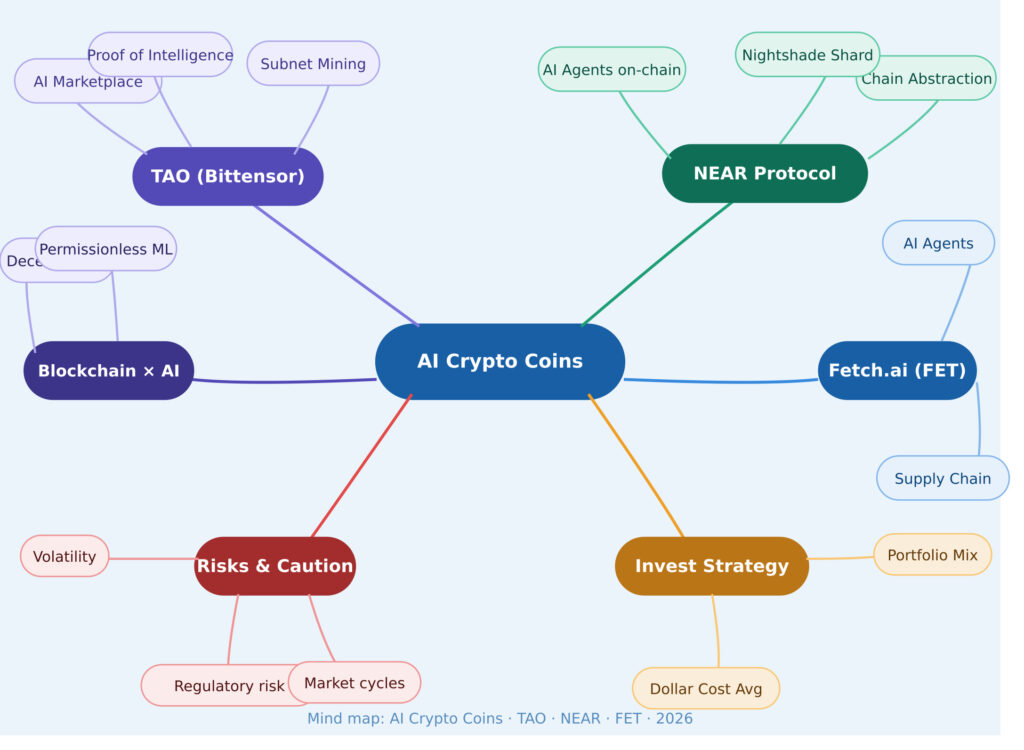
AI crypto coins like TAO, NEAR, and FET represent three distinct but complementary visions of what decentralised AI infrastructure could look like. Bittensor is building the decentralised AI marketplace where your machine learning model is your miner. NEAR Protocol is building the universal layer through which AI agents will transact across all chains seamlessly. Fetch.ai is building the autonomous agent economy where AI programs earn and spend money on your behalf.
None of these projects are guaranteed successes. All three carry real risk. But all three are solving real problems with thoughtful technical approaches and growing developer communities. For investors willing to do their homework and accept the volatility that comes with early-stage crypto assets, AI crypto coins represent one of the most interesting areas of the market in 2026.
The future of intelligence is being decentralized, one subnet, one shard, one agent at a time. The question is whether you want to understand it — and potentially participate in it — before it becomes mainstream news.
Whether you are brand new to crypto or a seasoned portfolio builder, understanding AI crypto coins 2026 gives you a meaningful edge as the convergence of artificial intelligence and blockchain enters its next chapter.
This article is for educational and informational purposes only and does not constitute financial or investment advice. Always conduct your own research and consult a qualified financial advisor before making investment decisions.