Investing in the stock market can feel overwhelming, especially for beginners. One of the most common questions investors face is:
Should I invest in Index Funds or Active Funds?
This debate has been ongoing for decades among financial experts and investors. Both strategies aim to grow wealth over time, but they use very different approaches.
Understanding the difference between Index Funds vs Active Funds can help you choose an investment strategy that matches your financial goals, risk tolerance, and long-term plans.
In this beginner-friendly guide, we will explore:
- What index funds are
- What active funds are
- Key differences between them
- Pros and cons of each strategy
- Which one is better for long-term investors
Let’s break it down in a simple and practical way.
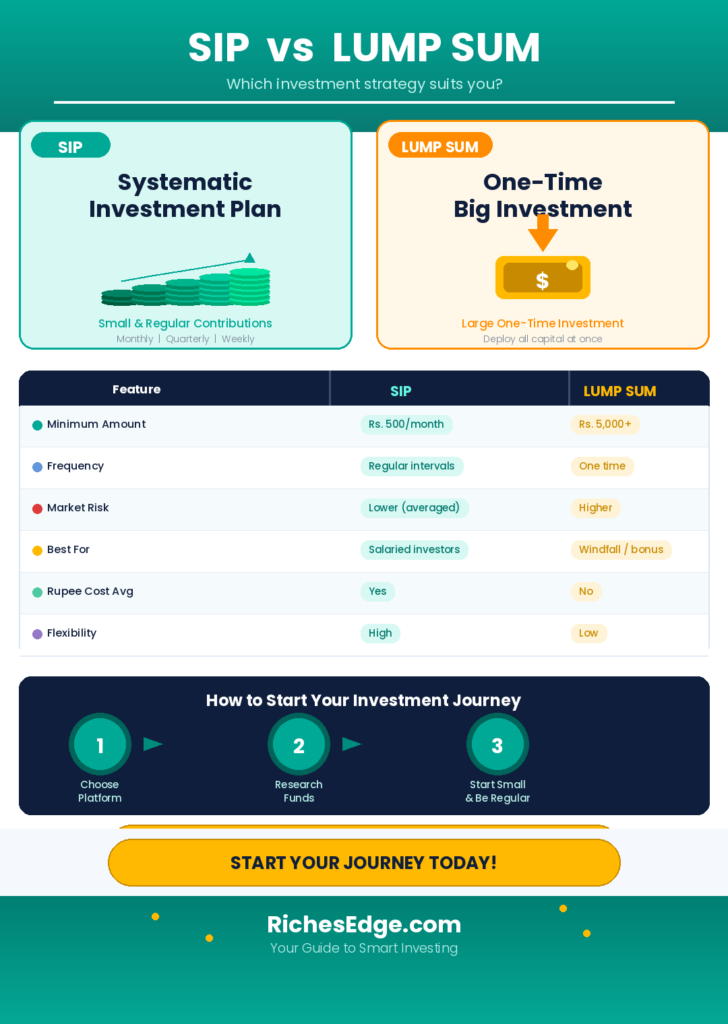
For official mutual fund regulations, visit the SEBI website.If you are new to investing, you may also like our guide on SIP vs Lump Sum Investment Strategy.
What Are Index Funds?
An Index Fund is a type of mutual fund or exchange-traded fund (ETF) designed to track the performance of a specific market index.
Instead of trying to beat the market, index funds simply replicate the market’s performance.
For example:
- Nifty 50 Index Fund tracks the Nifty 50
- Sensex Index Fund tracks the BSE Sensex
- S&P 500 Index Fund tracks the US S&P 500
These funds invest in the same companies and in the same proportion as the index they track.
Example
If the Nifty 50 index contains companies like:
- Reliance Industries
- HDFC Bank
- Infosys
- TCS
The index fund will hold these stocks in similar weightage.
This approach is known as Passive Investing.
What Are Active Funds?
Active funds are mutual funds where professional fund managers actively choose investments with the goal of outperforming the market.
Instead of copying an index, fund managers:
- Research stocks
- Analyze companies
- Predict market trends
- Buy and sell securities frequently
The aim is simple:
Beat the market and generate higher returns.
Active funds rely heavily on the skills and decisions of the fund manager.
Some popular categories include:
- Large Cap Funds
- Flexi Cap Funds
- Mid Cap Funds
- Sector Funds
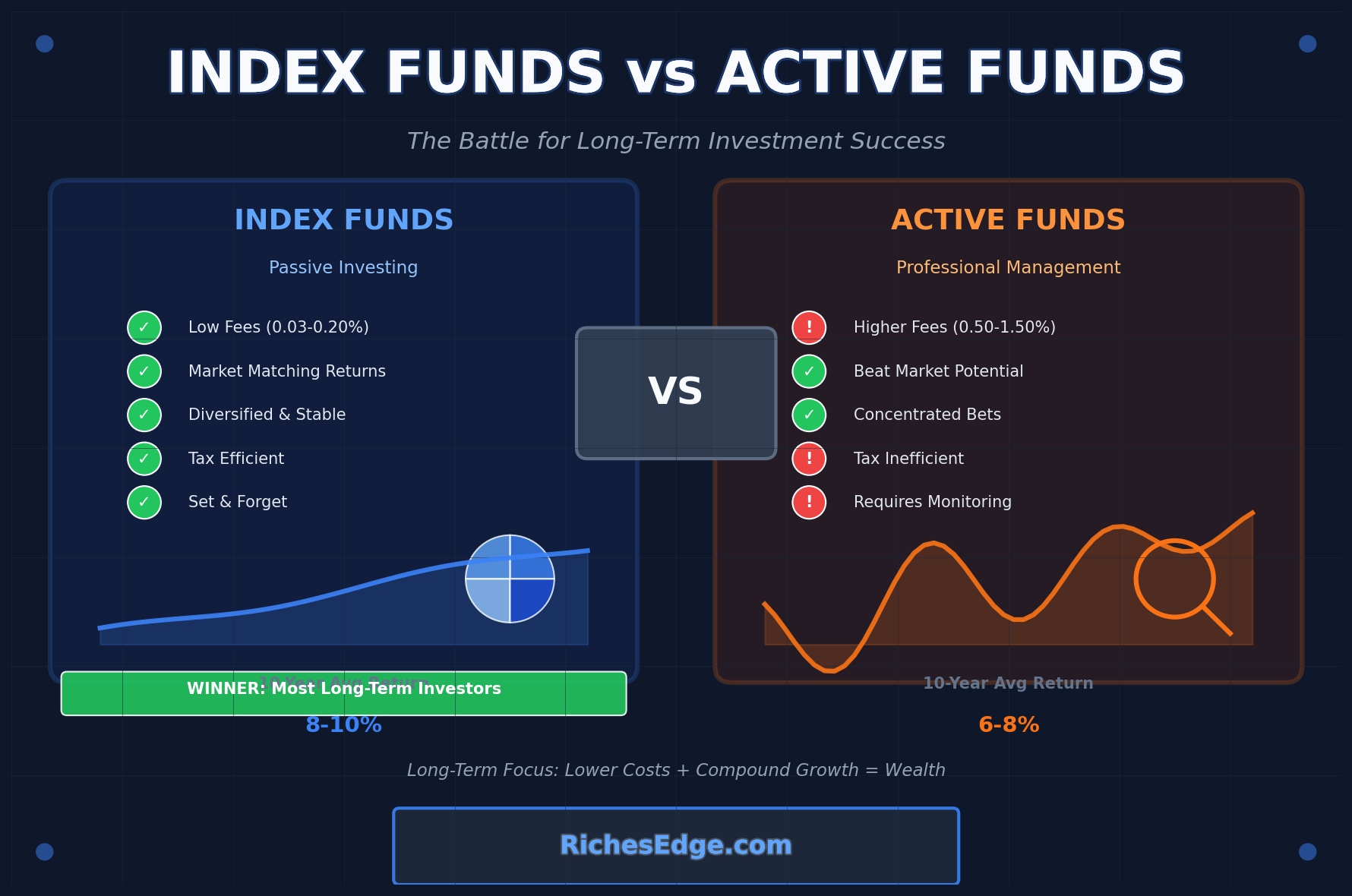
Index Funds vs Active Funds: Key Differences
| Feature | Index Funds | Active Funds |
|---|---|---|
| Investment Strategy | Passive | Active |
| Goal | Match market returns | Beat market returns |
| Fund Management | No active manager decisions | Managed by professionals |
| Expense Ratio | Low | Higher |
| Trading Frequency | Minimal | Frequent |
| Risk Level | Market risk | Market + manager risk |
The biggest difference in the Index Funds vs Active Funds debate is cost and consistency of performance.
Index Funds vs Active Funds Performance Comparison
A major reason many investors prefer index funds is consistent long-term performance.
Studies show that many active funds struggle to beat the market over long periods.
There are several reasons:
- High fees reduce overall returns
- Market timing is extremely difficult
- Human decisions can sometimes be wrong
Because index funds simply follow the market, they deliver market returns without trying to predict trends.
Over long investment horizons like 10–20 years, passive investing has often performed competitively or even better than many actively managed funds.
Cost and Expense Ratios
When comparing Index Funds vs Active Funds, one of the biggest differences investors notices is the expense ratio.
Index Fund Costs
Index funds are much cheaper because they require very little management.
Typical expense ratio:
0.05% – 0.5%
Active Fund Costs
Active funds involve research teams, fund managers, and trading activity.
Typical expense ratio:
1% – 2.5%
Even a small difference in fees can significantly impact long-term returns.
For example:
If you invest ₹10 lakh for 20 years:
- A 1.5% higher fee could reduce your final wealth by lakhs of rupees.
This is one of the biggest reasons why passive investing has gained popularity.
Risk Factors to Consider
In the discussion of Index Funds vs Active Funds, understanding the risk profile of both strategies is essential for long-term investors.
Index Fund Risks
- Market downturn affects the fund
- No chance of outperforming the market
Active Fund Risks
- Poor fund manager decisions
- High expense ratios
- Inconsistent performance
In the debate of Index Funds vs Active Funds, investors must consider both market risk and management risk.
When Index Funds May Be Better
Index funds are usually better for investors who:
- Prefer low-cost investing
- Want long-term wealth creation
- Do not want to monitor the market frequently
- Believe in passive investing
They are ideal for:
- Beginners
- Retirement planning
- SIP investing
- Long-term portfolios
Many financial advisors recommend index funds as the core of a diversified portfolio.
When Active Funds May Be Useful
Active funds can sometimes outperform the market, especially in certain segments like:
- Mid-cap stocks
- Small-cap stocks
- Emerging sectors
They may be suitable for investors who:
- Are comfortable with higher risk
- Want potential market outperformance
- Trust professional fund managers
However, selecting the right active fund requires proper research.
What Experts Say About Passive Investing
The popularity of Index Funds vs Active Funds discussions has increased as more investors adopt passive investing strategies.
Many renowned investors and institutions support index investing.
For example, legendary investor Warren Buffett has repeatedly recommended low-cost index funds for most investors.
According to several market studies, a large percentage of actively managed funds fail to outperform benchmark indexes over long periods.
Because of this, passive investing strategies are becoming increasingly popular among long-term investors.
Best Strategy for Long-Term Investors
The best strategy may not be choosing one over the other.
Many investors use a hybrid approach.
Example portfolio:
- 60–70% Index Funds
- 30–40% Active Funds
This approach provides:
- Market stability
- Professional stock selection
- Diversification benefits
Combining both strategies can help balance risk and potential returns.
Related Articles
- Best Mutual Funds for Beginners in India
- SIP vs Lump Sum: Which Investment Strategy Is Better in 2026?
- Direct vs Regular Mutual Funds: 7 Key Differences Every Smart Investor Must Know (2026)
Final Verdict
The debate of Index Funds vs Active Funds does not have a single universal answer.
Both strategies have their advantages and disadvantages.
However, for most beginner investors:
Index funds offer simplicity, low cost, and consistent market returns.
Active funds may still be useful in specific sectors where skilled fund managers can add value.
The most important factor is staying invested for the long term and maintaining a disciplined investment approach.
Remember:
Successful investing is not about predicting the market — it is about time in the market.
Frequently Asked Questions
Are index funds safer than active funds?
Index funds are not risk-free, but they usually have lower management risk compared to actively managed funds.
Can active funds beat index funds?
Yes, some active funds outperform the market. However, consistently beating the index over long periods is difficult.
Are index funds good for beginners?
Yes. Index funds are often considered one of the best starting points for new investors.
Should long-term investors prefer passive investing?
Many experts recommend passive investing because of low costs and stable market returns.
For official mutual fund regulations, always use trusted financial sources.