Investing always involves a balance between risk and reward. Understanding Risk vs Return is one of the most important principles every investor should learn before putting money into any asset.
Many beginners believe that investing is only about choosing the option that gives the highest return. However, experienced investors know that every potential return comes with a level of risk.
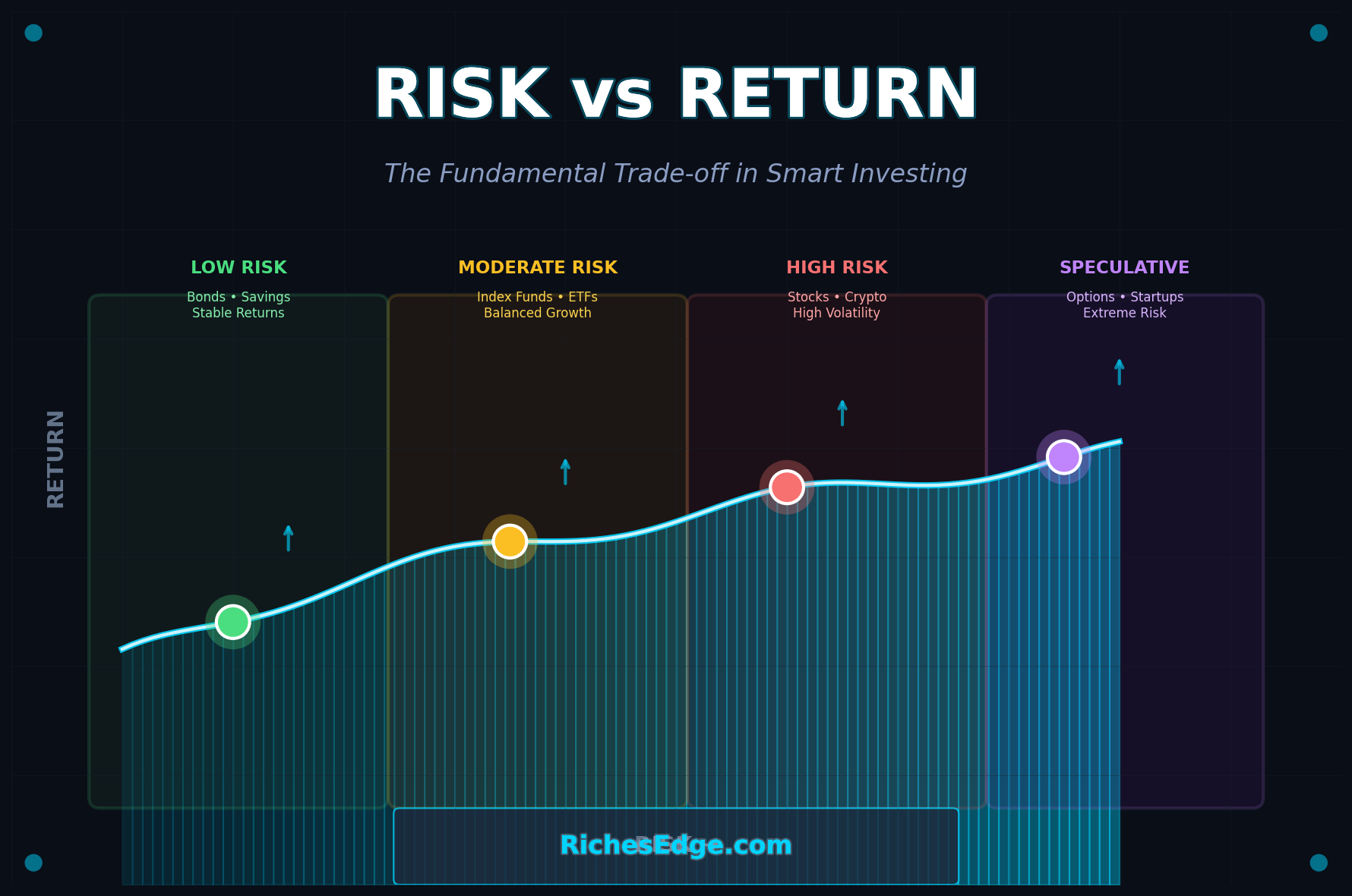
In simple terms, the Risk vs Return relationship means that investments offering higher potential returns usually involve higher levels of risk. On the other hand, safer investments generally provide lower returns.
Learning this relationship can help investors make smarter investment decisions, reduce losses, and build long-term wealth.
This guide explains Risk vs Return in investing, why it matters, and how beginners can use it to build a balanced investment strategy.
What is Risk in Investing
Risk refers to the possibility of losing money or earning lower returns than expected.
Every investment carries some level of uncertainty. Markets fluctuate due to economic conditions, global events, company performance, and many other factors.
For example:
- Stock markets can decline suddenly.
- Interest rates can change.
- Inflation can reduce the real value of money.
Because of these factors, investors must always consider the level of risk before investing.
Different assets carry different levels of risk.
Examples include:
Low Risk Investments
- Savings accounts
- Government bonds
- Fixed deposits
Moderate Risk Investments
- Mutual funds
- Balanced funds
- ETFs
High Risk Investments
- Stocks
- Cryptocurrency
- Startups
Understanding these differences helps investors evaluate the Risk and Return in Investing.
What is Return in Investing
Return refers to the profit or gain earned from an investment over time.
Returns can come in different forms.
Capital Gains
When the value of an asset increases and is sold at a higher price.
Example:
Buying a stock at ₹100 and selling it at ₹150.
Dividend Income
Some companies distribute a portion of their profits to shareholders.
Interest Income
Investments like bonds and fixed deposits pay interest regularly.
Return is usually expressed as a percentage of the investment amount.
For example:
If you invest ₹10,000 and earn ₹1,000 profit, the return is 10%.
Understanding Risk vs Return Relationship
The concept of Risk vs Return explains that investors must take on higher risk to achieve higher potential rewards.
This is known as the Risk-Return Tradeoff.
Example:
| Investment | Risk Level | Expected Return |
|---|---|---|
| Savings Account | Very Low | Low |
| Government Bonds | Low | Low to Moderate |
| Mutual Funds | Moderate | Moderate |
| Stocks | High | High |
| Cryptocurrency | Very High | Very High |
In general:
- Low risk = lower returns
- High risk = higher potential returns
However, high risk does not guarantee higher profits. It only increases the possibility of higher gains.
Types of Investment Risks
Understanding different types of risks helps investors make informed decisions.
Market Risk
Market risk occurs when the entire financial market declines due to economic events.
Example:
Stock market crashes.
Inflation Risk
Inflation reduces the purchasing power of money.
If an investment grows slower than inflation, the real return becomes negative.
Interest Rate Risk
Changes in interest rates affect bonds and fixed-income investments.
Credit Risk
Credit risk occurs when borrowers fail to repay loans or bonds.
Liquidity Risk
Some investments cannot be sold quickly without losing value.
Real estate is a common example.
Learning these risks improves understanding of Investment Risk vs Return Explained.
Examples of Risk vs Return in Different Investments
Different asset classes demonstrate the relationship between risk and return.
Fixed Deposits
Risk Level: Low
Return: 5-7%
FDs are considered safe investments but offer limited growth.
Mutual Funds
Risk Level: Moderate
Return: 10-15% (historically)
Mutual funds provide diversification and professional management.
Stocks
Risk Level: High
Return: 12-18% (long term average)
Stocks can deliver strong growth but also experience volatility.
Cryptocurrency
Risk Level: Very High
Return: Highly unpredictable
Crypto markets can generate large profits or significant losses.
These examples clearly show how Risk vs Return influences investment choices.
How Investors Measure Risk and Return
Professional investors use several metrics to evaluate investments.
Standard Deviation
Measures how much investment returns fluctuate.
Higher deviation means higher risk.
Sharpe Ratio
Measures return compared to risk.
A higher Sharpe Ratio indicates better risk-adjusted performance.
Beta
Measures how sensitive an investment is compared to the market.
Example:
- Beta greater than 1 = more volatile than market
- Beta less than 1 = less volatile
These metrics help investors understand Risk and Return in Investing more clearly.
Strategies to Balance Risk and Return
Successful investors focus on balancing risk rather than eliminating it.
Diversification
Diversification spreads investments across multiple asset classes.
Example portfolio:
- Stocks
- Mutual Funds
- Bonds
- Gold
- Real Estate
Diversification reduces overall risk.
Asset Allocation
Asset allocation determines how investments are divided across asset categories.
Example allocation for beginners:
Stocks – 50%
Mutual Funds – 30%
Bonds – 10%
Gold – 10%
Long-Term Investing
Long-term investing reduces the impact of short-term market volatility.
Regular Investing
Systematic Investment Plans (SIPs) allow investors to invest regularly and reduce market timing risk.
Common Mistakes Investors Make
Many investors misunderstand Risk vs Return and make costly mistakes.
Chasing High Returns
Investors sometimes choose risky investments purely based on high return expectations.
Ignoring Diversification
Investing in only one asset increases risk significantly.
Panic Selling
Market volatility causes emotional decisions.
Selling during market downturns locks in losses.
Lack of Research
Investing without understanding the risk profile leads to poor financial outcomes.
Tips for Beginners to Manage Investment Risk
If you are new to investing, follow these practical strategies.
Start Small
Begin with smaller investments and increase gradually.
Build an Emergency Fund
Having emergency savings prevents forced withdrawals during market downturns.
Understand Your Risk Tolerance
Each investor has different financial goals and risk appetite.
Invest Consistently
Regular investing builds wealth gradually.
Stay Patient
Wealth creation takes time and discipline.
Related Articles
- How to Create a Simple Investment Plan for Long-Term Wealth
- How to Calculate Mutual Fund Returns (CAGR vs XIRR Explained)
- How to Start Investing with ₹5,000 in India (Beginner Guide)
Final Thoughts
Understanding Risk vs Return is essential for building a successful investment strategy.
Instead of chasing the highest returns, smart investors focus on balancing risk and reward.
By learning how different investments behave and diversifying portfolios, investors can achieve stable long-term growth.
Remember:
Successful investing is not about avoiding risk completely.
It is about managing risk intelligently while maximizing returns over time.
When investors understand the relationship between risk and return, they can make confident decisions and move closer to their financial goals.
Learn more about investing regulations from: