Understanding compounding is one of the most important concepts in finance and investing. Many financial experts believe that learning this principle early can completely change your financial future.
“Successful investing is not about timing the market, but about staying invested for the long term.”
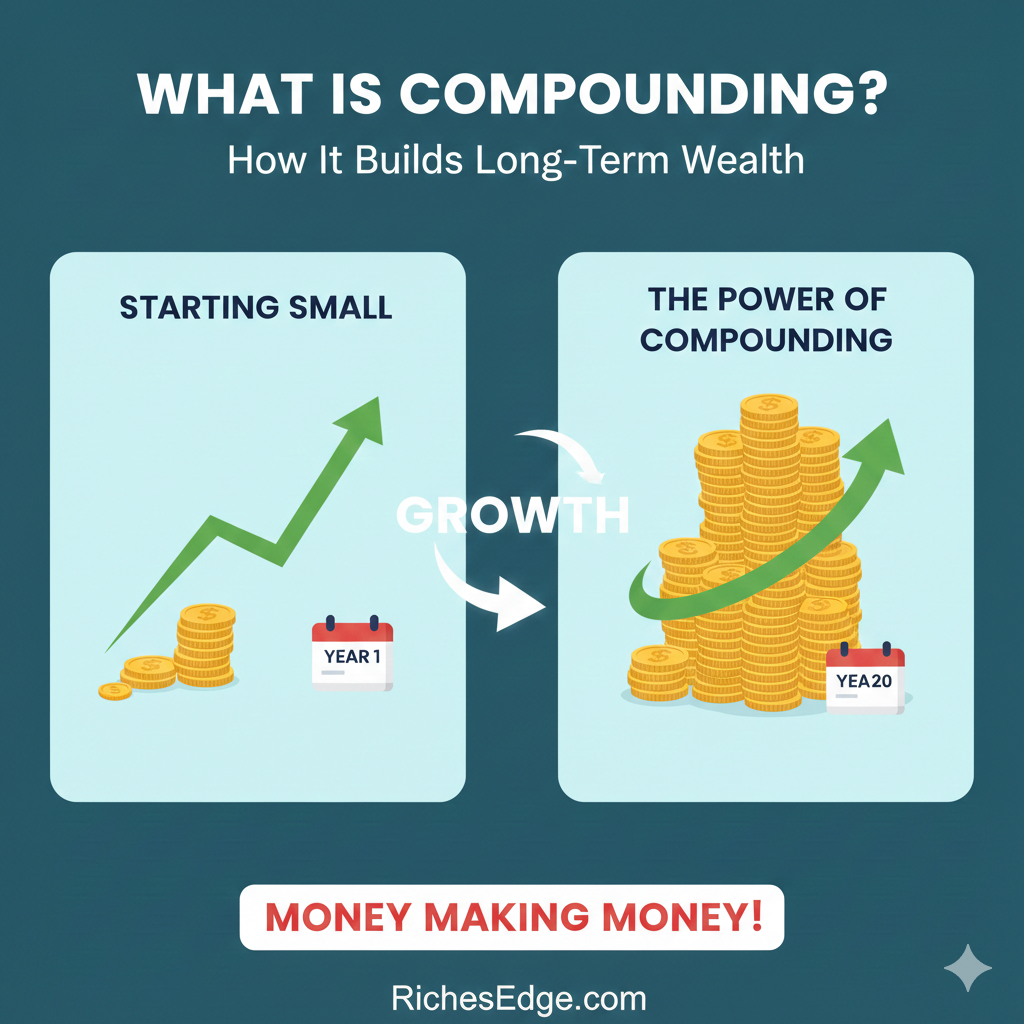
In simple terms, it means earning returns not only on your original investment but also on the gains that accumulate over time. Instead of generating profit only from the initial amount invested, your money starts producing returns on previous returns, creating exponential growth.
This is the reason why long-term investors, retirement planners, and mutual fund advisors always emphasize starting early and staying invested for the long run.
Legendary investor Warren Buffett has often highlighted that much of his wealth came from the power of long-term investment growth and reinvested returns.
In this guide, you will learn:
- What compounding means in investing
- How investment growth works over time
- Real-life examples of long-term wealth building
- Why time is the most powerful factor in investing
- How beginners can use this strategy to grow wealth
Let’s understand this powerful financial principle in the simplest way possible.
What Is Compounding in Finance
Compounding in finance refers to the process where earnings generated from an investment are reinvested to generate additional earnings.
In other words:
You earn interest not only on your initial investment (principal) but also on the interest already earned.
This creates a snowball effect, where your money starts growing faster over time.
Simple definition
Compounding =
Interest on principal + interest on accumulated interest
This continuous reinvestment leads to exponential growth of wealth.
For example:
If you invest ₹10,000 and earn 10% annually:
Year 1 → ₹11,000
Year 2 → ₹12,100
Year 3 → ₹13,310
Your returns start generating returns themselves.
How the Power of Compounding Works
The power of compounding works based on three important factors that influence long-term investment growth.
1. Time
The longer you stay invested, the stronger your investment growth becomes. Time allows reinvested returns to accumulate and multiply over the years.
2. Rate of Return
Higher returns can significantly accelerate wealth creation. Even a small difference in annual return can lead to a large difference in final investment value over long periods.
3. Consistent Investment
Regular investing helps your money grow steadily. Contributions made through monthly investments such as SIPs allow returns to build on top of previous gains.
In the early years, the growth may appear slow and sometimes unnoticeable. However, over time the investment curve becomes steeper and the results become more visible.
Many investors underestimate this effect because they expect quick profits. In reality, long-term investing rewards patience, consistency, and disciplined financial planning.
Simple Example of Compounding
Let’s compare two investors.
Investor A
Invests ₹10,000 for 20 years at 12%.
Final Value ≈ ₹96,463
Investor B
Invests ₹10,000 for 30 years at 12%.
Final Value ≈ ₹299,600
Notice something interesting.
Investor B only invested 10 years more, but the final value became 3 times larger.
This is the true power of compounding.
Time multiplies wealth dramatically.
The Rule of 72 Explained
The Rule of 72 is a simple formula that helps estimate how long it takes for an investment to double.
Formula:
Years to double = 72 ÷ Interest Rate
Example:
Return = 12%
72 ÷ 12 = 6 years
Your money will double approximately every 6 years.
Example timeline:
Year 0 → ₹1,00,000
Year 6 → ₹2,00,000
Year 12 → ₹4,00,000
Year 18 → ₹8,00,000
This shows how powerful compounding becomes over long periods.
Why Time Is the Most Powerful Factor
Albert Einstein reportedly called compounding the “eighth wonder of the world.”
The reason is simple.
Time multiplies growth dramatically.
Consider two investors.
Early Investor
Starts at age 25
Invests ₹5,000/month
Late Investor
Starts at age 35
Invests ₹5,000/month
Assuming 12% return until age 60.
Early investor wealth ≈ ₹1.76 crore
Late investor wealth ≈ ₹57 lakh
Starting 10 years earlier created 3× more wealth.
This proves a key lesson:
Start early, even with small investments.
Compounding in Mutual Funds and SIP
One of the best ways to benefit from compounding is through Systematic Investment Plans (SIP) in mutual funds.
SIPs allow investors to invest small amounts regularly.
Each investment grows and compounds over time.
Benefits include:
- Rupee cost averaging
- Long-term wealth creation
- Discipline in investing
- Lower risk compared to lump-sum investing
For example:
Invest ₹5,000 per month in a mutual fund for 20 years.
Total investment = ₹12,00,000
Assuming 12% return:
Final value ≈ ₹49,95,000
Nearly 4× growth due to compounding.
You can explore mutual fund investing guidelines from official sources:
Benefits of Compounding
Compounding offers several powerful advantages for investors.
Exponential Wealth Growth
Returns grow faster over time.
Passive Income Growth
Reinvested earnings generate more income.
Long-Term Financial Security
Compounding helps build retirement wealth.
Inflation Protection
Investments that compound can outpace inflation.
Works Even with Small Investments
You don’t need large capital to start benefiting from compounding.
Consistency matters more than the amount.
Common Mistakes Investors Make
Even though compounding is a powerful wealth-building concept, many investors fail to fully benefit from it due to common investing mistakes.
Here are some of the most common ones:
Starting Too Late
Time is the most important factor in long-term investing. When people delay investing for many years, they lose valuable time that allows investments to grow and multiply. Starting early—even with small amounts—can significantly improve long-term wealth.
Withdrawing Investments Too Early
Frequent withdrawals interrupt the growth cycle of your investments. When returns are reinvested and allowed to stay invested for longer periods, they can generate additional earnings and accelerate overall growth.
Lack of Investment Discipline
Irregular investing habits can slow down wealth creation. Consistent investing—such as monthly contributions through SIPs or retirement plans—helps build a stable long-term portfolio.
Chasing Short-Term Profits
Many investors focus on quick profits instead of long-term financial growth. Successful investors understand that patience and disciplined investing are key to achieving sustainable wealth.
How Beginners Can Use Compounding to Build Wealth
Here are simple strategies beginners can follow.
Start Investing Early
Even small amounts grow big over time.
Invest Consistently
Monthly investments help maximize compounding.
Reinvest Returns
Avoid withdrawing gains unless necessary.
Choose Long-Term Assets
Examples include:
- Mutual funds
- Index funds
- Retirement funds
- Dividend reinvestment plans
Stay Invested
The longer you stay invested, the stronger compounding becomes.
Real Life Example of Compounding Wealth
Let’s look at a realistic scenario.
Monthly SIP: ₹10,000
Return: 12% annually
Investment period: 25 years
Total invested: ₹30,00,000
Final value ≈ ₹1.89 crore
Most of this growth happens in the last 10 years due to compounding acceleration.
This is why financial advisors say:
“Time in the market beats timing the market.”
Why Financial Experts Always Recommend Compounding
Most successful investors strongly believe in the power of long-term investing because compounding rewards patience. Instead of focusing on short-term profits, experienced investors focus on consistent growth over decades.
Financial planners often recommend starting investments early because even small investments can grow significantly over time. For example, investing ₹3000 every month in an equity mutual fund for 25 years can potentially grow into a large financial corpus.
The key idea is simple: time multiplies the effect of investment returns.
Related Articles
- How to Start Investing with ₹5,000 in India (Beginner Guide)
- How to Create a Simple Investment Plan for Long-Term Wealth
- How to Calculate Mutual Fund Returns (CAGR vs XIRR Explained)
Final Thoughts
Compounding is one of the most powerful wealth-building tools available to investors.
It rewards patience, discipline, and long-term thinking.
The earlier you start investing, the greater the impact compounding will have on your financial future.
Even small investments can grow into significant wealth if given enough time.
So the best time to start investing was yesterday.
The second best time is today.
Remember:
Consistency + Time + Compounding = Long-Term Wealth