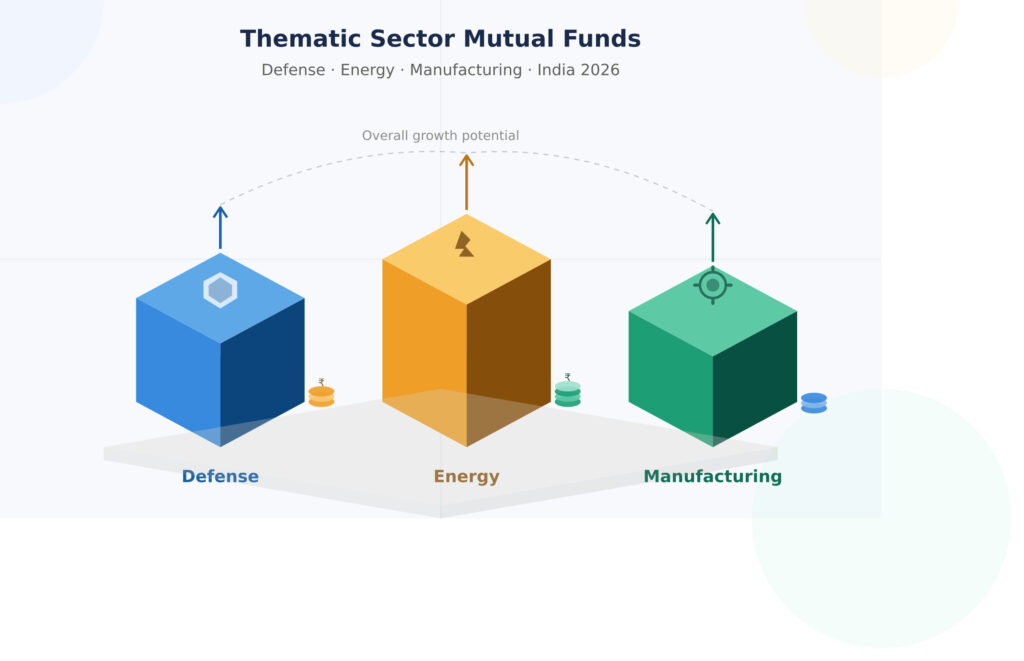
Thematic mutual funds are changing the way smart Indian investors build wealth — and in 2026, three sectors are stealing the spotlight: Defense, Energy, and Manufacturing. Whether you are a seasoned investor looking to add some firepower to your portfolio or a curious beginner trying to understand what all the buzz is about, this guide breaks it all down in plain, honest language.
Buckle up. This is going to be fun.
What Are Thematic Mutual Funds?
Thematic mutual funds are equity mutual funds that concentrate their entire investment portfolio around a specific economic theme or sector. Instead of diversifying broadly across industries, these funds make a concentrated, high-conviction bet on one powerful story — defense, energy, manufacturing, technology, or consumption.
Here is the simplest way to think about it:
A regular diversified equity fund is like ordering a full thali — a little bit of everything, balanced and reliable. A thematic mutual fund is like ordering the best biryani in town and doubling down on it because you genuinely believe that kitchen is about to become the most famous restaurant in the city.
According to AMFI’s Categorization of Mutual Fund Schemes, thematic and sector funds must invest a minimum of 80% of their assets in stocks related to their declared theme or sector. This concentration is both the source of their exciting return potential and their biggest risk.
In India, SEBI classifies these into two types:
- Sectoral Funds — Invest exclusively within a single industry (only defense stocks, only banking stocks, only pharma stocks).
- Thematic Funds — Invest across multiple industries united by one overarching theme (e.g., “Make in India” spans manufacturing, logistics, capital goods, and infrastructure).
Both belong to the thematic mutual funds universe. Both are high-risk, high-reward by design.
Why Thematic Mutual Funds Are Trending in 2026
India in 2026 is a very different economy from what it was just five years ago. Three massive structural forces are reshaping where money flows:
1. Geopolitical repositioning — India’s defense budget crossed ₹6 lakh crore in 2025-26, and with rising border tensions and a government push for indigenous weapons development, defense stocks are no longer just a patriotic investment — they’re a financial thesis.
2. Energy transition — The global pivot from fossil fuels to renewables is gathering pace. India’s National Solar Mission targets, coupled with NTPC’s massive green energy expansion and private sector capex in wind and solar, have made the energy sector a fascinating mix of old-school oil majors and new-age clean energy players.
3. Manufacturing renaissance — China+1 is not just a buzzword. Global supply chains are actively diversifying, and India — with its Production Linked Incentive (PLI) schemes, improved infrastructure, and skilled workforce — is the biggest beneficiary. Electronics, chemicals, auto components, and textiles are all part of this story.
These three themes explain why thematic sector mutual funds in India — specifically in Defense, Energy, and Manufacturing — have attracted record inflows over the past 18 months.
Defense Sector Thematic Mutual Funds — Riding India’s Military Boom
The Big Picture
India is the world’s third-largest military spender, and the government has been on a mission to indigenize defense production. The slogan “Atmanirbhar Bharat” (self-reliant India) is not just political rhetoric — it translates directly into procurement orders for Indian defense companies.
The Ministry of Defense has restricted imports of hundreds of defense items, mandating they be produced locally. This is rocket fuel (quite literally) for companies like Hindustan Aeronautics Limited (HAL), Bharat Electronics Limited (BEL), Bharat Dynamics Limited (BDL), Mazagon Dock Shipbuilders, and Garden Reach Shipbuilders.
What Defense Sector Mutual Funds Invest In
A typical defense sector mutual fund in India will have exposure to:
- Public Sector Undertakings (PSUs) like HAL, BEL, BDL
- Private defense manufacturers like Paras Defence, Data Patterns, Ideaforge
- Ancillary suppliers and MRO (Maintenance, Repair, Overhaul) companies
- Space technology companies post the space sector liberalization
Top Defense Thematic Mutual Funds in India (2026)
- HDFC Defence Fund
- Mirae Asset Nifty India Defence ETF
- SBI Defence Opportunities Fund
- Aditya Birla Sun Life PSU Equity Fund (partial defense exposure)
Key Stocks These Funds Hold
| Company | Role |
|---|---|
| Hindustan Aeronautics (HAL) | Fighter jets, helicopters |
| Bharat Electronics (BEL) | Radar, sonar, communication systems |
| Bharat Dynamics (BDL) | Missiles and torpedoes |
| Mazagon Dock Shipbuilders | Naval warships and submarines |
| Data Patterns | Defense electronics |
Risk-Return Profile
| Parameter | Details |
|---|---|
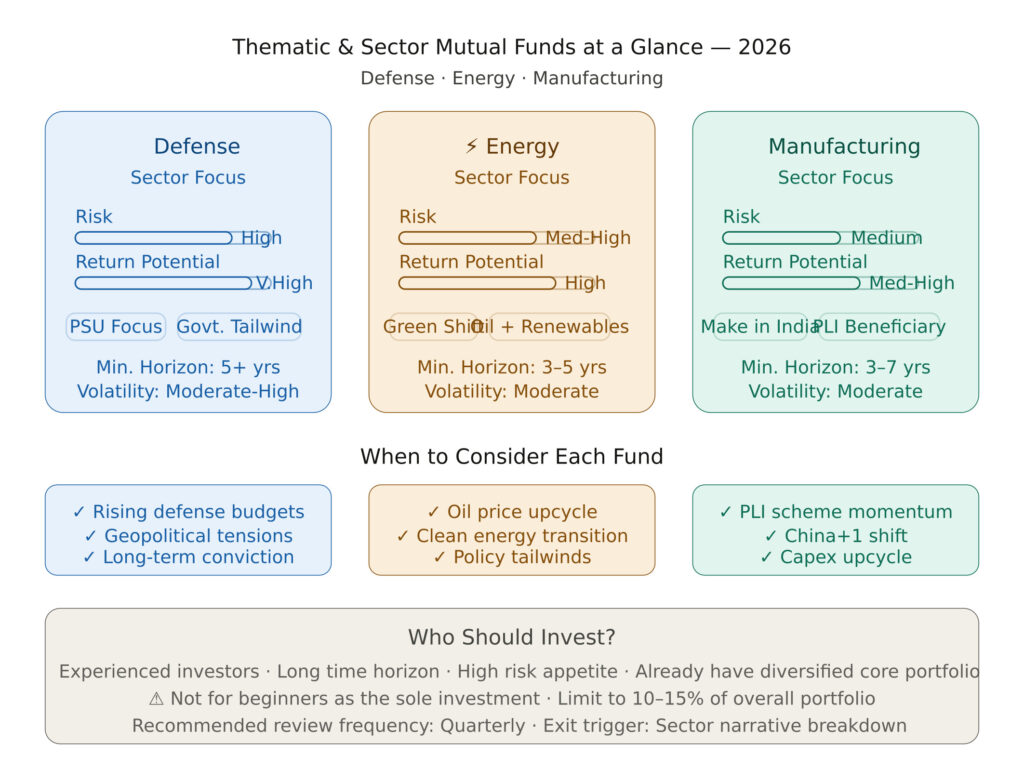
| Risk Level | High |
| Return Potential | Very High (but lumpy) |
| Minimum Horizon | 5+ years |
| Volatility | Moderate to High |
| Ideal Investor | High-risk tolerance, believes in India’s defense story |
The Honest Caveat
Defense stocks are heavily dependent on government policy. An election outcome, a budget cut, or a peace treaty can send these stocks tumbling. These are not set-and-forget investments. You need to track quarterly order books, earnings calls, and ministry announcements.
Energy Thematic Mutual Funds — From Oil Wells to Solar Panels
The Big Picture
Energy is arguably the most fascinating sector in India right now because it is undergoing a split personality transformation. On one hand, companies like Reliance Industries, ONGC, and Indian Oil are printing money from petroleum refining and gas exploration. On the other, NTPC Green Energy, Adani Green, and Torrent Power are building massive solar and wind capacity.
An energy sector mutual fund in 2026 often captures both worlds, making it a uniquely diversified bet within the “concentrated” theme.
What Energy Sector Mutual Funds Invest In
- Oil & gas upstream companies (ONGC, Oil India)
- Downstream refiners (Indian Oil, BPCL, HPCL)
- Power generation companies (NTPC, Tata Power, Adani Green)
- Renewable energy infrastructure
- Energy transmission companies (Power Grid Corporation)
Top Energy Thematic Mutual Funds in India (2026)
- DSP Natural Resources and New Energy Fund
- Tata Resources & Energy Fund
- Nippon India Power & Infra Fund
- SBI Energy Opportunities Fund
- ICICI Prudential Energy Opportunities Fund
Risk-Return Profile
| Parameter | Details |
|---|---|
| Risk Level | Medium-High |
| Return Potential | High |
| Minimum Horizon | 3–5 years |
| Volatility | Moderate (with crude oil sensitivity) |
| Ideal Investor | Moderate-to-high risk appetite, believes in India’s energy security story |
The Fun Part Nobody Talks About
Here’s something interesting — crude oil price movements create a natural hedge within many energy funds. When crude is high, upstream companies like ONGC surge. When crude is low, downstream companies (refiners) benefit because their margins expand. So a well-constructed energy fund can perform across different oil price environments. Clever, right?
Manufacturing Thematic Mutual Funds — Make in India, Profit in India
The Big Picture
If there’s one theme that is clearly the government’s darling in 2026, it is manufacturing. The PLI (Production Linked Incentive) schemes launched across 14 sectors have committed over ₹2 lakh crore in incentives. The results are starting to show — Apple manufactures iPhones in Chennai, Samsung has expanded its Noida plant, and dozens of global semiconductor companies are in various stages of establishing India facilities.
Manufacturing sector mutual funds are designed to capture this capex supercycle across:
- Capital goods
- Auto and auto ancillaries
- Electronics and semiconductors
- Chemicals
- Textiles and apparel
- Infrastructure equipment
Top Manufacturing Thematic Mutual Funds in India (2026)
- Mirae Asset Great Consumer Fund (partial manufacturing theme)
- ICICI Prudential Manufacturing Fund
- Canara Robeco Manufacturing Fund
- Nippon India Manufacturing Fund
- Kotak Manufacturing in India Fund
Risk-Return Profile
| Parameter | Details |
|---|---|
| Risk Level | Medium |
| Return Potential | Medium-High |
| Minimum Horizon | 3–7 years |
| Volatility | Moderate |
| Ideal Investor | Long-term investor, believes in India’s industrial growth story |
The PLI Advantage Nobody Is Pricing In
Here’s a fun fact: the full financial impact of PLI schemes on corporate earnings is still being underestimated by the broader market. Many PLI-linked projects are in gestation and will only start generating meaningful revenue from 2025-27. A manufacturing mutual fund bought today could be holding the beneficiaries of PLI payouts that haven’t even been announced yet.
Thematic Mutual Funds vs. Sector Funds: Key Differences
This confuses a lot of people — and fund houses sometimes use the terms interchangeably, which doesn’t help.
Here’s the simplest way to understand it:
A Sector Fund is narrow. It invests only in one industry — only banking stocks, only pharma stocks, only defense stocks. The definition is tight.
A Thematic Fund is broader but still focused. “India’s manufacturing renaissance” is a theme — it can include capital goods companies, auto ancillaries, logistics players, and semiconductor firms. “Energy transition” is a theme — it can include solar panels, batteries, EV companies, and utilities.
The practical difference for investors:
- Sector funds are more concentrated → higher risk, higher reward potential
- Thematic funds have slightly more diversification within the theme → marginally lower risk, still high potential
Both are significantly more volatile than a diversified equity fund or an index fund. This is not a place for your emergency fund or your home loan down payment savings.
Risks of Thematic Mutual Funds You Cannot Ignore
Let’s be completely honest here. Thematic sector mutual funds are exciting, but they come with a set of risks that you need to respect:
1. Concentration Risk — All your eggs are in one basket. If that basket gets dropped, there’s no cushion.
2. Cyclicality — Sectors go through cycles. The energy sector was in the doldrums for years before the 2021-24 upcycle. Defense was a sideshow before the Galwan clash. Timing entry and exit is genuinely difficult.
3. Policy Risk — What the government gives, the government can take away. A change in defense procurement policy, an import duty reshuffle, or a subsidy cut can devastate sector-specific stocks overnight.
4. Valuation Risk — When a theme becomes “hot,” money pours in, valuations get stretched, and returns compress. Many thematic funds in 2025 were trading at PE multiples that were 40-50% above their historical averages.
5. Exit Liquidity — In a downturn, everyone exits a sector fund at the same time. NAV can fall sharply and quickly.
Mitigation strategy: Never let any single thematic fund exceed 10-15% of your total portfolio. Treat it as a satellite position, not your core.
Who Should Invest in Thematic Mutual Funds?
You ARE a good fit if:
- You already have a core diversified portfolio (large-cap, flexi-cap, or index fund)
- You have a minimum 5-year investment horizon
- You have high risk tolerance — you can watch your NAV drop 30% without panicking and selling
- You have strong conviction in the specific sector narrative
- You understand the sector you’re investing in (at least at a headline level)
You are NOT a good fit if:
- This is your only or primary investment
- You’re investing money you’ll need within 3 years
- You plan to check your portfolio daily and react to market movements
- You’re a complete beginner — start with an index fund first
How to Pick the Right Thematic Sector Mutual Fund
With dozens of thematic sector mutual funds on the market, here’s a simple checklist:
1. Fund Age & Track Record — Prefer funds with at least 3-5 years of history. New funds launched at the peak of a sector rally are red flags.
2. AUM Size — Very small AUMs (under ₹500 crore) can have liquidity issues. Very large AUMs can struggle to generate alpha. The sweet spot for sector funds is ₹1,000–₹8,000 crore.
3. Expense Ratio — Direct plans are always cheaper. Compare expense ratios: for sector funds, 0.5%–1.2% (direct) is reasonable.
4. Fund Manager Experience — Check how the fund manager has navigated previous sector downturns. Has this fund manager managed money through a bear market in this sector?
5. Portfolio Concentration — Check the top 10 holdings. If the top 5 stocks make up 60%+ of the portfolio, you’re taking very concentrated bets.
6. Rolling Returns — Look at 3-year rolling returns, not just point-to-point returns. This tells you the consistency of performance across different market conditions.
7. Benchmark Comparison — How does the fund perform versus its benchmark index (e.g., Nifty India Defence Index, Nifty Energy Index) after expenses? Consistent outperformance is the goal.
FAQs — Thematic Mutual Funds in India 2026
1: What is the difference between thematic mutual funds and diversified equity funds?
Thematic mutual funds concentrate 80% or more of their portfolio within a single sector or economic theme — such as Defense, Energy, or Manufacturing. A diversified equity fund, by contrast, spreads investments across multiple sectors simultaneously to reduce concentration risk. The key tradeoff is straightforward: thematic mutual funds offer higher return potential when their chosen theme is performing well, but they can underperform significantly when the theme faces headwinds. Diversified funds deliver smoother, more consistent long-term returns with far less volatility.
2: Are thematic mutual funds suitable for beginners?
Generally, thematic mutual funds are not recommended as a starting point for beginner investors. Because these funds concentrate heavily in one sector, they can experience sharp NAV swings — sometimes 30-40% drawdowns in a single market downturn — which can be emotionally and financially difficult for new investors to handle. Beginners are better served starting with a large-cap index fund or a flexi-cap fund to build a stable financial foundation first. Once that core portfolio is in place, allocating a small portion — 10-15% — to thematic mutual funds becomes a much more manageable and sensible decision.
3: How much of my portfolio should I allocate to thematic mutual funds?
Most financial advisors and experienced investors recommend limiting thematic mutual funds to no more than 10-15% of your total investment portfolio. This sizing keeps the potential upside meaningful while ensuring that a sector-specific downturn does not devastate your overall financial plan. If you want exposure to multiple themes — say, both a Defense and a Manufacturing thematic mutual fund — each individual fund should ideally stay within 5-8% of your total portfolio so your combined thematic exposure remains controlled.
4: What is the minimum investment horizon for thematic mutual funds?
The recommended minimum investment horizon for thematic mutual funds is 5 years, and ideally 7-10 years for full cycle returns. Sectors go through extended periods of underperformance before their structural story plays out in stock prices. Defense thematic mutual funds, for instance, may require patience through multiple quarterly earning cycles and government budget announcements before the full return potential materializes. Investing in thematic mutual funds with a short time horizon of 1-2 years is a common mistake that often results in disappointing returns and unnecessary stress.
5: Can I invest in thematic mutual funds through SIP?
Yes — and SIP (Systematic Investment Plan) is actually the preferred mode of investing in thematic mutual funds for most investors. Because these funds can be highly volatile, investing a fixed amount every month through SIP allows you to average your purchase cost across different market levels — a strategy called rupee cost averaging. This reduces the risk of entering at a peak valuation, which is a particularly common and costly mistake with thematic mutual funds that have recently generated strong returns and attracted heavy media attention.
6: How do I know when to exit a thematic mutual fund?
Exiting a thematic mutual fund should be driven by a change in the investment thesis, not by short-term NAV movements. Ask yourself: has the fundamental reason you invested in this theme changed? For example, if you invested in a Defense thematic mutual fund because of rising government defense budgets, and the government subsequently announces a major cut in defense spending, that is a thesis-breaking event worth acting on. On the other hand, if the NAV dropped because of a broader market correction while the sector fundamentals remain intact, that is typically a reason to stay invested — or even increase your SIP amount — rather than exit.
7: Which thematic mutual funds have given the best returns in recent years?
Over the 3-year period ending 2025-26, thematic mutual funds in the Defense and Infrastructure themes delivered some of the highest returns in the entire mutual fund universe, with several funds generating 35-55% CAGR during peak cycles. Manufacturing thematic mutual funds also performed strongly, benefiting from PLI-driven earnings upgrades across capital goods and electronics companies. However, it is critical to note that past performance of thematic mutual funds is not indicative of future results — especially when entry valuations are significantly higher than they were at the start of those high-return periods. Always evaluate current valuations before investing, not just historical return charts.
Related Articles
- SIP vs Lump Sum: Which Investment Strategy Is Better in 2026?
- Direct vs Regular Mutual Funds: 7 Key Differences Every Smart Investor Must Know (2026)
- Best Mutual Funds for Beginners in India
Final Verdict — Are Thematic Mutual Funds Worth It in 2026?
Thematic mutual funds in Defense, Energy, and Manufacturing are genuinely exciting opportunities in 2026 — but they are tools for sophisticated investors with conviction, patience, and a robust core portfolio already in place.
If you believe that India is going to be a global defense exporter by 2030, a clean energy leader by 2035, and a manufacturing powerhouse that rivals China, then these funds are your high-octane vehicles to ride those trends.
If you’re still figuring out the basics of investing, do yourself a favour — start with an index fund. Build your financial base. Then, once you have a stable core, allocate 10-15% to a thematic sector fund where you have genuine conviction and understanding.
The best investors aren’t the ones who pick the hottest sector. They’re the ones who understand the story, stay patient through the volatility, and exit when the narrative changes — not when their neighbours start talking about it.
Now that’s a strategy worth investing in.
⚠️ Disclaimer: This article is for educational and informational purposes only. It does not constitute financial advice. Please consult a SEBI-registered investment advisor before making any investment decisions. Mutual fund investments are subject to market risks. Please read all scheme-related documents carefully.