Introduction
How to Calculate Mutual Fund Returns is one of the most important skills every investor must learn. Whether you are investing through SIPs or lump sum investments, understanding your actual returns helps you make smarter financial decisions.
Many beginners often get confused between CAGR vs XIRR, and end up misjudging their portfolio performance. But don’t worry — this guide will break everything down in a simple, practical, and engaging way.
By the end of this article, you will:
- Understand how mutual fund returns are calculated
- Learn the difference between CAGR vs XIRR
- Know when to use each method
- Be able to calculate returns yourself
What Are Mutual Fund Returns?
Mutual fund returns represent the profit or loss generated from your investment over a specific time period.
There are two major ways to measure returns:
- Absolute Returns
- Annualized Returns (CAGR, XIRR)
👉 If you’re serious about investing, you should always focus on annualized returns, as they give a realistic performance picture.
Why Calculating Mutual Fund Returns is Important
Understanding How to Calculate Mutual Fund Returns helps you:
- Track performance accurately
- Compare different funds
- Make better investment decisions
- Avoid misleading returns
💡 Example: A fund showing 50% return in 5 years is not as impressive as it sounds — annualized returns tell the real story.
Types of Mutual Fund Return Calculation
1. Absolute Return
Simple but misleading for long-term investments.
Formula:
(Current Value - Investment Value) / Investment Value × 100
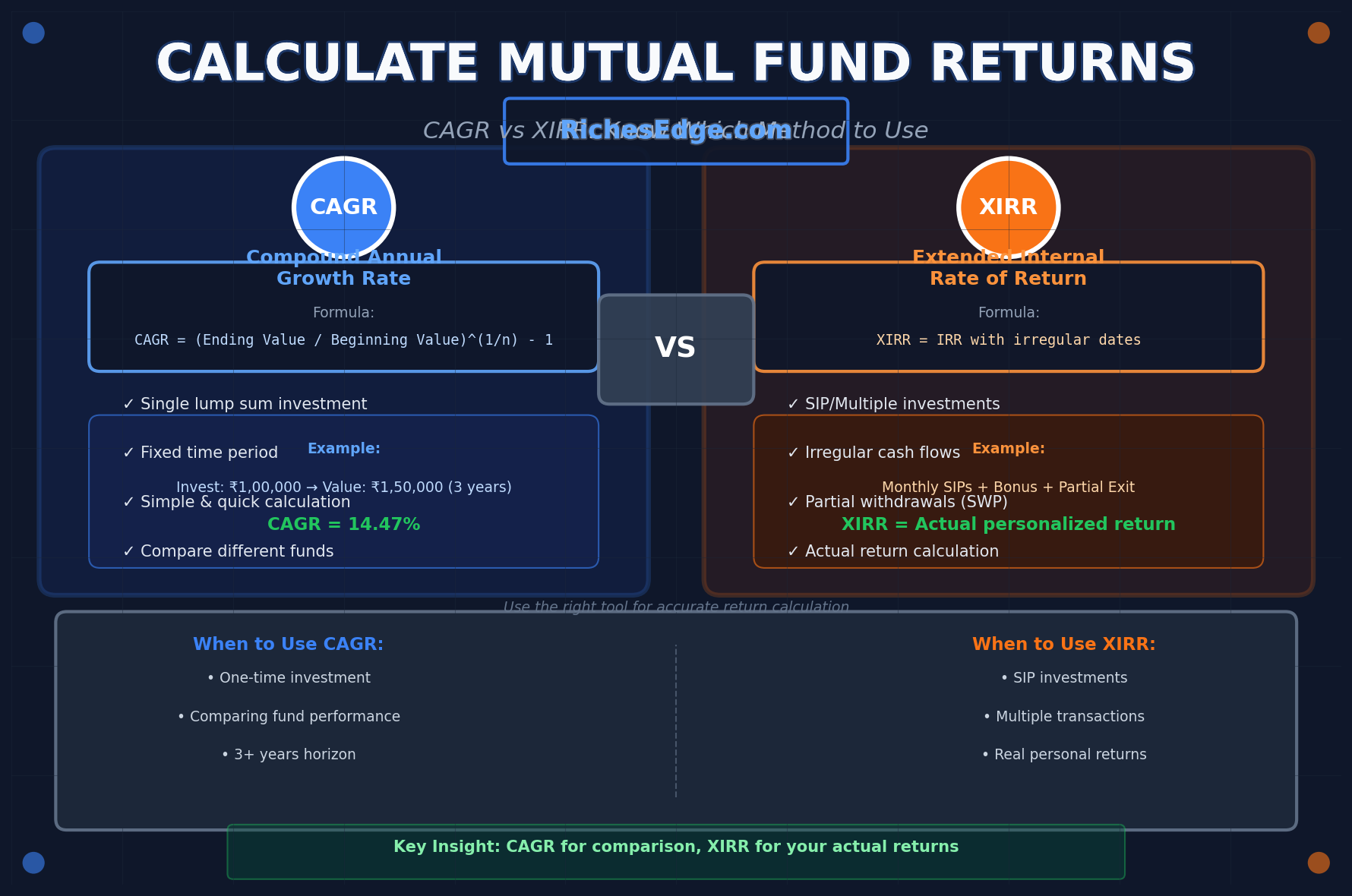
2. CAGR (Compound Annual Growth Rate)
Used for:
✔ Lump sum investments
✔ Long-term investments
3. XIRR (Extended Internal Rate of Return)
Used for:
✔ SIP investments
✔ Multiple cash flows
What is CAGR in Mutual Funds?
CAGR stands for Compound Annual Growth Rate. It shows the average annual return of your investment over time.
📌 CAGR Formula:
CAGR = (Final Value / Initial Investment) ^ (1 / Number of Years) - 1
Example of CAGR
- Invested: ₹1,00,000
- Value after 5 years: ₹1,80,000
CAGR ≈ 12.47%
👉 This means your investment grew at 12.47% annually.
When to Use CAGR
- One-time investment
- No additional deposits
- Long-term performance tracking
What is XIRR in Mutual Funds?
XIRR stands for Extended Internal Rate of Return. It is used when investments happen at different times.
Why XIRR Matters
If you invest via SIP (monthly), CAGR becomes inaccurate. That’s where XIRR helps.
Example of XIRR
- ₹5,000 invested monthly
- Duration: 3 years
- Final Value: ₹2,40,000
XIRR might be around 14–16%, depending on timing.
When to Use XIRR
- SIP investments
- Multiple transactions
- Irregular investments
CAGR vs XIRR – Key Differences
| Feature | CAGR | XIRR |
|---|---|---|
| Investment Type | Lump sum | SIP / Multiple |
| Accuracy | Moderate | High |
| Cash Flow Handling | No | Yes |
| Ease of Calculation | Easy | Slightly complex |
👉 Conclusion:
Use XIRR for accuracy
Use CAGR for simplicity
Real-Life Example (CAGR vs XIRR)
Scenario 1: Lump Sum
- ₹1,00,000 invested
- Value = ₹2,00,000 after 5 years
👉 CAGR = 14.87%
Scenario 2: SIP
- ₹5,000 monthly for 5 years
- Value = ₹4,20,000
👉 XIRR ≈ 12–14%
💡 Even if total investment is same, returns differ due to timing.
Common Mistakes to Avoid
- Using CAGR for SIP investments
- Ignoring time duration
- Not considering cash flow timing
- Comparing funds incorrectly
- Looking only at absolute returns
Tools to Calculate Mutual Fund Returns
You don’t always need manual calculation.
Popular Tools:
- Excel (XIRR formula)
- Online calculators
- Investment apps
💡 Excel Formula:
=XIRR (values, dates)
How Inflation Impacts Mutual Fund Returns
When learning how to calculate mutual fund returns, most beginners forget one crucial factor — inflation.
Let’s make it simple 👇
If your mutual fund gives 10% return, but inflation is 6%, your real return is only 4%.
👉 Formula (simplified):
Real Return = Return – Inflation
💡 Example:
- Investment Return: 12%
- Inflation: 7%
- Real Return: 5%
That means your money is growing, but not as fast as you think.
🎯 Why this matters:
- Helps in realistic financial planning
- Prevents overestimation of wealth
- Important for long-term goals like retirement
👉 Pro Insight:
Always compare CAGR vs inflation to understand true performance.
The Power of Compounding in Mutual Fund Returns
Compounding is the real magic behind wealth creation — and it plays a huge role in how to calculate mutual fund returns.
Think of compounding as:
👉 “Earning returns on your returns”
🌱 Example:
- Invest ₹1,00,000 at 12% CAGR
- After 10 years → ~₹3,10,000
- After 20 years → ~₹9,60,000
😲 Notice the jump? That’s compounding at work!
🚀 Why it matters:
- Time > Timing the market
- Long-term investors benefit the most
- Even small SIPs grow significantly
💡 Fun Analogy:
Compounding is like a snowball rolling downhill — it starts small but grows bigger and faster over time ❄️
👉 Pro Tip:
The earlier you start, the more powerful CAGR becomes.
Expert Tips for Beginners
- Always check XIRR for SIPs
- Compare funds using the same metric
- Focus on long-term performance
- Avoid short-term noise
- Track returns yearly
Visual Understanding
Imagine your investment journey like this:
- CAGR = Straight Road 🚗
- XIRR = Road with multiple stops 🛣️
👉 XIRR gives a more realistic journey experience.
💡 Pro Insight:
Don’t chase the highest returns — choose consistent and reliable performance.
FAQs
1. What is better CAGR or XIRR?
XIRR is better for SIP investments, while CAGR is suitable for lump sum investments.
2. Can I use CAGR for SIP?
No, it will give inaccurate results. Use XIRR instead.
3. What is a good XIRR return?
Typically, 12–15% is considered good in equity mutual funds.
4. Is XIRR always higher than CAGR?
Not necessarily. It depends on investment timing.
5. Can mutual fund returns be negative even if I stay invested for a long time?
Yes, mutual fund returns can be negative in the short term due to market volatility. However, over a longer period (5–10+ years), equity mutual funds have historically shown positive returns. This is why understanding how to calculate mutual fund returns using CAGR or XIRR is important to evaluate long-term performance accurately.
Related Articles
- Direct vs Regular Mutual Funds: 7 Key Differences Every Smart Investor Must Know (2026)
- Best Mutual Funds for Beginners in India
- SIP vs Lump Sum: Which Investment Strategy Is Better in 2026?
Final Thoughts
Understanding How to Calculate Mutual Fund Returns is not just a technical skill — it’s a financial superpower.
If you rely only on absolute returns, you might make poor investment decisions. But by mastering CAGR vs XIRR, you gain clarity, confidence, and control over your investments.
👉 Remember:
- Use CAGR for lump sum
- Use XIRR for SIP
- Always think long-term
Trusted official sources to understand mutual funds, CAGR, and XIRR in detail: