Introduction
Debt vs Equity Mutual Funds is one of the most common dilemmas every beginner investor faces. If you’ve ever wondered whether to play it safe or aim for higher returns, you’re not alone.
Imagine standing at a crossroads:
- One path offers stability and predictable returns
- The other offers growth and wealth creation potential
That’s exactly what choosing between debt and equity mutual funds feels like.
In this detailed guide, you’ll learn:
- What debt and equity funds are
- Key differences between them
- Risk vs return comparison
- When to choose which
- Real-life examples
- Smart strategies used by experienced investors
Let’s simplify investing and help you make the best financial decision
What Are Mutual Funds?
Before comparing Debt vs Equity Mutual Funds, let’s understand mutual funds.
A mutual fund pools money from multiple investors and invests it in assets like:
- Stocks
- Bonds
- Government securities
A professional fund manager handles everything.
👉 This makes mutual funds ideal for beginners.
What Is Debt Mutual Funds?
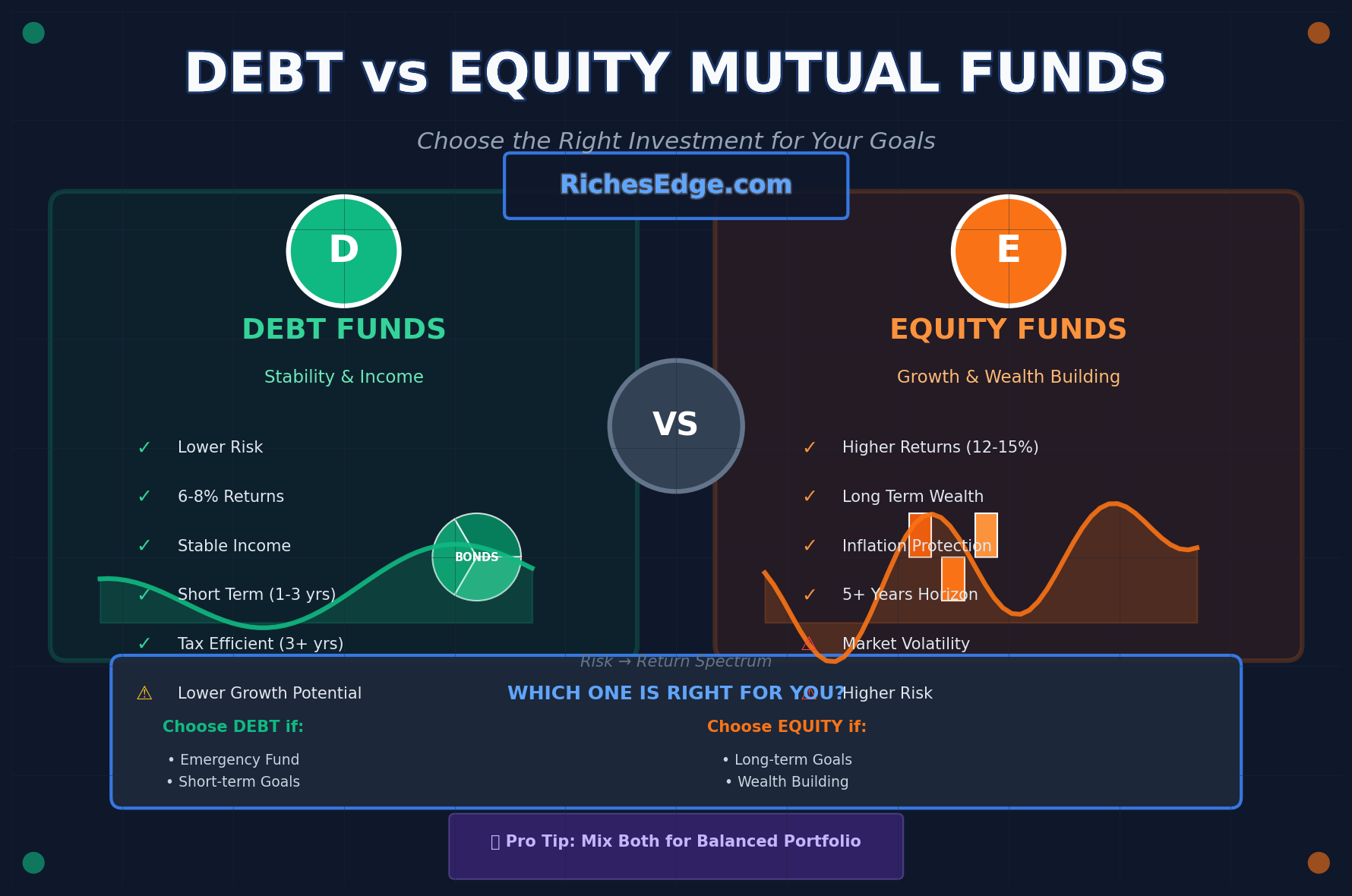
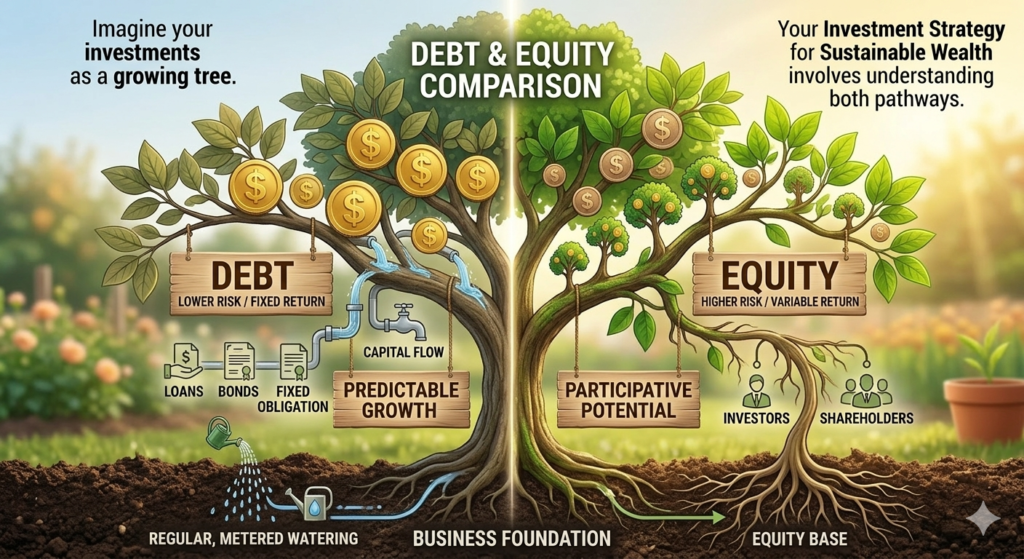
Debt mutual funds invest in fixed-income securities such as:
- Government bonds
- Corporate bonds
- Treasury bills
Key Features:
- Low risk
- Stable returns
- Ideal for short-term goals
- Less volatility
Example:
If you want to park money for 1–3 years, debt funds are a good option.
What Is Equity Mutual Funds?
Equity mutual funds invest primarily in stocks of companies.
Key Features:
- High returns (long-term)
- Higher risk
- Market-linked performance
- Ideal for wealth creation
Example:
If your goal is retirement or long-term wealth, equity funds are better.
Types of Debt and Equity Mutual Funds You Should Know
Understanding different categories helps you make better decisions in Debt vs Equity Mutual Funds.
Types of Debt Mutual Funds:
- Liquid Funds (very short-term, low risk)
- Short Duration Funds
- Corporate Bond Funds
- Gilt Funds (government securities)
Types of Equity Mutual Funds:
- Large Cap Funds (stable, less risky)
- Mid Cap Funds (moderate risk)
- Small Cap Funds (high risk, high return)
- ELSS (tax-saving funds)
👉 For beginners:
- Start with large-cap equity funds
- Use liquid or short-duration debt funds
This clarity improves your understanding of equity mutual funds vs debt funds and helps in better fund selection.
Key Differences: Debt vs Equity Mutual Funds
| Feature | Debt Mutual Funds | Equity Mutual Funds |
|---|---|---|
| Risk | Low | High |
| Returns | Stable | High (long-term) |
| Investment Horizon | Short to medium | Long-term |
| Volatility | Low | High |
| Ideal For | Safety & liquidity | Wealth creation |
👉 This table clearly highlights the difference between debt and equity mutual funds.
How to Choose Between Debt vs Equity Mutual Funds (Step-by-Step Framework)
Choosing between Debt vs Equity Mutual Funds becomes easy when you follow a structured approach.
Step 1: Identify Your Goal
Ask yourself:
- Short-term (1–3 years)? → Go with debt funds
- Long-term (5+ years)? → Equity funds are better
Step 2: Understand Your Risk Appetite
- If market fluctuations make you uncomfortable → Debt funds
- If you can handle ups and downs → Equity funds
Step 3: Check Investment Horizon
Time plays a crucial role:
- Less time = Less risk (Debt)
- More time = Higher growth (Equity)
Step 4: Liquidity Needs
Need quick access to money?
→ Debt funds are more suitable
Step 5: Combine Smartly
You don’t always need to choose one. A mix of both can create a balanced portfolio.
👉 This framework simplifies the decision in the debt funds vs equity funds India debate.
Risk vs Return Comparison
Debt Funds:
- Returns: 4%–8%
- Risk: Low
- Suitable for conservative investors
Equity Funds:
- Returns: 10%–15% (long-term)
- Risk: High
- Suitable for aggressive investors
👉 The core of Debt vs Equity Mutual Funds lies in this trade-off.
Taxation Differences in India
Understanding taxes is crucial when comparing debt funds vs equity funds India.
Debt Funds Taxation:
- Taxed as per income slab
- No indexation benefit (recent changes)
Equity Funds Taxation:
- LTCG (Long-Term Capital Gains): 10% above ₹1 lakh
- STCG (Short-Term): 15%
👉 Equity funds are more tax-efficient for long-term investors.
When Should You Choose Debt Funds?
Choose debt funds if:
✔ You want capital protection
✔ You have short-term goals (1–3 years)
✔ You prefer low-risk investments
✔ You need regular income
Ideal Scenarios:
- Emergency fund
- Saving for a vacation
- Parking idle cash
When Should You Choose Equity Funds?
Choose equity funds if:
✔ You want high returns
✔ You can stay invested for 5+ years
✔ You can tolerate market fluctuations
✔ You want wealth creation
Ideal Scenarios:
- Retirement planning
- Child education
- Long-term goals
Hybrid Strategy – Best of Both Worlds
Smart investors don’t always choose one—they combine both.
Example Allocation:
- 70% Equity
- 30% Debt
This strategy:
- Reduces risk
- Maintains growth
- Balances portfolio
👉 This is called asset allocation.
Real-Life Example
Let’s understand equity mutual funds vs debt funds with an example.
Investor A (Debt Funds):
- Invests ₹1 lakh
- Earns 6% annually
- After 5 years = ~₹1.34 lakh
Investor B (Equity Funds):
- Invests ₹1 lakh
- Earns 12% annually
- After 5 years = ~₹1.76 lakh
👉 Higher returns come with higher risk.
Common Mistakes to Avoid
❌ Investing in equity for short-term goals
❌ Ignoring risk tolerance
❌ Not diversifying portfolio
❌ Panic selling during market dips
❌ Choosing funds based only on past returns
Pro Tips for Smart Investors
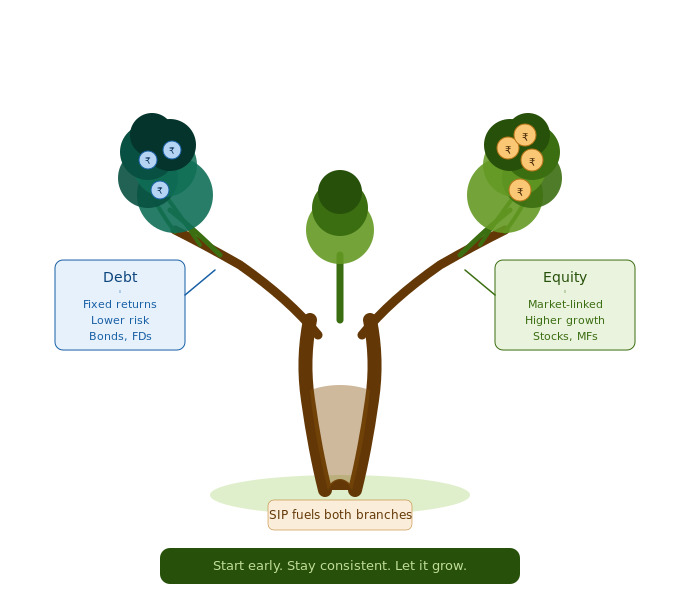
✔ Start with SIP (Systematic Investment Plan)
✔ Stay invested long-term
✔ Review portfolio annually
✔ Diversify across fund types
✔ Align investments with goals
FAQs
Which is better: debt or equity mutual funds?
It depends on your goals. Debt is safer; equity offers higher returns.
Can beginners invest in equity funds?
Yes, but start with SIP and long-term perspective.
Are debt funds completely safe?
They are low-risk but not risk-free.
Can I invest in both?
Yes, combining both is the best strategy.
Related Articles
- Direct vs Regular Mutual Funds: 7 Key Differences Every Smart Investor Must Know (2026)
- Best Mutual Funds for Beginners in India
- SIP vs Lump Sum: Which Investment Strategy Is Better in 2026?
Final Thoughts
Debt vs Equity Mutual Funds is not about choosing one over the other—it’s about choosing what fits your goals.
- Want safety? → Debt Funds
- Want growth? → Equity Funds
- Want balance? → Combine both
The smartest investors understand one simple truth:
👉 “It’s not about timing the market, but about time in the market.”
Start small, stay consistent, and let your money grow 🌱
For official mutual fund regulations, always use trusted financial sources.