What Is AI-Driven Investing?
AI-driven investing is exactly what it sounds like — using artificial intelligence to make smarter, faster, and more data-backed investment decisions. Instead of a human analyst spending hours pouring over charts, earnings reports, and news articles, an AI system processes millions of data points in milliseconds and identifies patterns that human eyes would never catch.
Think of it this way: imagine you had a genius assistant who never sleeps, never gets emotional about market dips, and has read every financial document ever written. That is essentially what an AI investing engine does for you.
AI-driven investing includes tools like:
- Robo-advisors (e.g., Betterment, Wealthfront) that automatically build and manage a portfolio for you
- Algorithmic trading systems that execute trades based on predefined rules and real-time data signals
- Natural Language Processing (NLP) models that scan news headlines, earnings call transcripts, and social media sentiment to predict stock movements
- Machine learning models that continuously learn from historical market data to improve future predictions
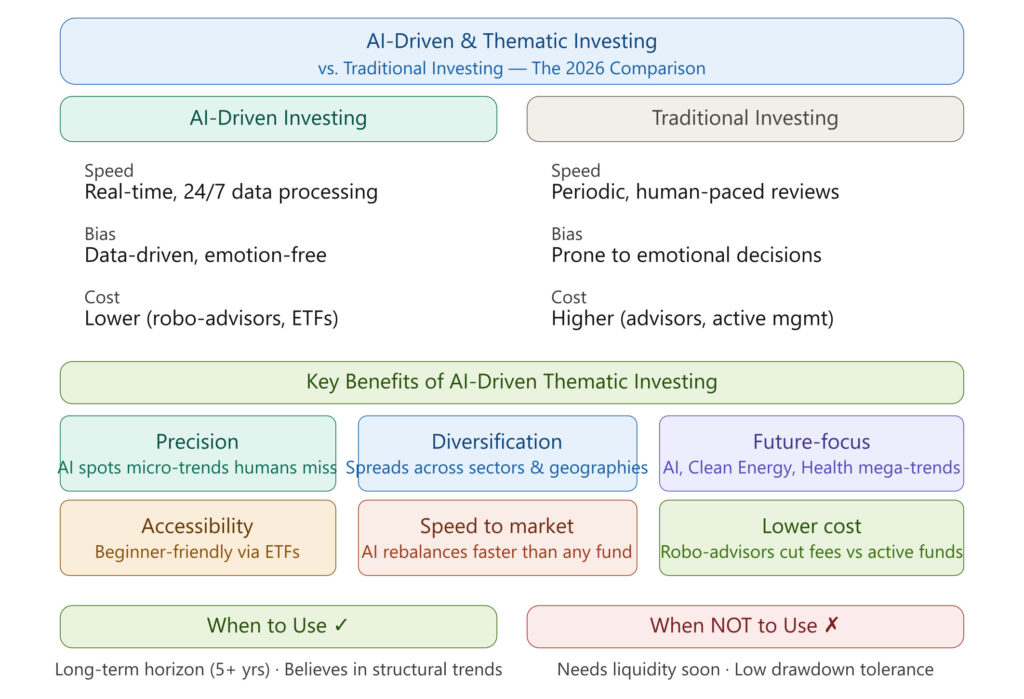
The key thing that separates AI-driven investing from traditional investing is not just speed — it is objectivity. Markets are driven by emotions: fear, greed, panic, and euphoria. AI removes all of that noise from the equation.
How AI Works in Investing
At its core, AI investing relies on a few technologies:
Machine Learning (ML): The AI is trained on historical market data, learns from patterns, and then applies those patterns to new data to predict future outcomes. For example, an ML model might learn that certain combinations of technical indicators historically precede a 10% stock rally within 30 days.
Natural Language Processing (NLP): NLP helps AI “read” text. When a company releases its quarterly earnings, an NLP model scans the language of the report and the CEO’s tone on the conference call to determine whether sentiment is positive, negative, or neutral — often before any human analyst can even finish reading the document.
Deep Learning: A more advanced form of ML, deep learning uses neural networks with multiple layers (inspired by how the human brain works) to detect extremely complex, non-linear relationships in financial data.
Key AI Tools Used in Investment Today
Some of the most widely used AI investing tools in 2026 include platforms like BlackRock’s Aladdin system (which manages over $21 trillion in assets), AI-powered ETFs from firms like Qraft Technologies, and consumer-facing apps like M1 Finance and SoFi that integrate machine learning recommendations directly into the user experience.
What Is Thematic Investing?
If AI-driven investing is the engine, thematic investing is the destination. Thematic investing is the strategy of building your portfolio around powerful, long-term structural trends that are reshaping the world economy — rather than just picking random stocks or following a traditional index.
Instead of asking “Which stock should I buy?”, a thematic investor asks: “What mega-trends will define the next 10–20 years?” And then invests accordingly.
Some of the most compelling themes right now include:
- Artificial Intelligence & Technology — Semiconductors, cloud computing, generative AI infrastructure
- Clean Energy & Climate Tech — Solar, wind, green hydrogen, EV charging networks
- Healthcare Innovation — Genomics, precision medicine, health AI diagnostics
- Electric Vehicles & Mobility — EV manufacturers, battery tech, autonomous driving
- Cybersecurity — As everything goes digital, protecting it becomes a massive industry
- Emerging Markets Consumer Growth — A rising middle class in Asia, Africa, and Latin America
Popular Thematic Investing Categories
Thematic investing is not a new concept, but what is new is how precisely AI can identify and track these themes in real-time. Traditionally, a fund manager would need to manually monitor hundreds of companies to decide which fit a particular theme. Today, AI does this automatically — continuously screening thousands of global stocks against a defined set of criteria, then flagging the ones that best represent a given theme.
Thematic ETFs vs. Individual Stocks
For most beginners (and even many experienced investors), thematic ETFs are the most practical way to invest in a theme. Instead of buying individual stocks — which requires deep research and careful risk management — a thematic ETF gives you exposure to a basket of companies all aligned with a single theme.
Some popular thematic ETFs include:
- ARKK (ARK Innovation ETF) — Focused on disruptive innovation including AI, genomics, and fintech
- ICLN (iShares Global Clean Energy ETF) — Exposure to renewable energy companies globally
- ROBO (ROBO Global Robotics and Automation ETF) — Robotics, AI, and automation companies
- FHLC (Fidelity MSCI Health Care ETF) — Healthcare sector exposure
- DRIV (Global X Autonomous & Electric Vehicles ETF) — EVs, autonomous vehicles, and related tech
Beginner Tip: Thematic ETFs are a great starting point because they give diversification within a theme, charge lower fees than active funds, and are easy to buy through any standard brokerage account.
How AI-Driven Investing Powers Thematic Strategies
Now here is where things get really interesting. When you combine AI-driven investing with thematic investing, you get something far more powerful than either approach on its own.
Here is how the synergy works:
1. AI Identifies Emerging Themes Faster
By analyzing global news feeds, patent filings, academic research publications, government policy announcements, and supply chain data simultaneously, AI can spot the early signals of a rising theme months or even years before it becomes mainstream. By the time the average retail investor reads about a trend in a newspaper, AI models have already been tracking it — and positioning portfolios accordingly.
2. AI Builds Better Thematic Portfolios
Once a theme is identified, AI doesn’t just pick any company within that theme. It uses quantitative analysis to select only those companies with the strongest fundamental indicators — revenue growth, margin expansion, R&D investment, insider buying, and more — to maximize the quality of companies within a thematic basket.
3. AI Manages Risk in Real-Time
Thematic investing carries the risk of concentration — if a single theme collapses (think: clean energy stocks during a policy reversal), the losses can be severe. AI monitors thematic portfolios around the clock and can automatically reduce exposure when risk signals spike, something a human fund manager simply cannot do with the same speed or consistency.
AI Identifies Emerging Themes Faster
One real-world example: In 2020, AI-powered investment systems began flagging unusual levels of investment and patent activity in mRNA biotechnology — months before the COVID vaccine rollout made it a household name. Investors with AI-powered thematic strategies were already positioned in companies like Moderna and BioNTech well before the general public understood what was happening.
Real-World Examples of AI + Thematic Investing
- BlackRock’s thematic AI funds use machine learning to screen over 15,000 global stocks and assign “theme scores” to each one, determining how closely aligned a company is to a given structural trend.
- Qraft Technologies launched AI-driven ETFs on the New York Stock Exchange that use deep learning to dynamically adjust thematic allocations based on changing market conditions.
- Endowus (Singapore) uses AI to offer personalized thematic portfolios for retail investors, tailoring exposure to themes like longevity, sustainability, and digital transformation based on individual risk profiles.
Benefits of AI-Driven Thematic Investing
Let’s break down why so many investors — from beginners to professionals — are turning to this approach:
1. Precision That Humans Cannot Match AI can analyze satellite imagery of retail parking lots to estimate foot traffic before earnings, scan 10,000 earnings transcripts in seconds, and track social media sentiment in real-time. This level of data processing simply is not humanly possible.
2. Emotion-Free Decision Making The biggest killer of investment returns is behavioral bias — panic-selling during a crash, overconfidence during a bull market. AI does not feel fear or greed. It follows the data, full stop.
3. Future-Focused by Design Thematic investing is inherently forward-looking. You are not investing in what worked in the past — you are investing in what will reshape the world over the next decade. AI makes sure you are positioned in the right themes at the right time.
4. Accessibility for Beginners Between robo-advisors, thematic ETFs, and AI-powered investing apps, you no longer need to be a Wall Street professional to invest intelligently. A 22-year-old with $500 can today access the same thematic investment strategies that used to require millions of dollars.
5. Lower Costs Than Active Management Traditional active fund managers charge high fees — often 1% to 2% per year — and most still underperform their benchmark index. AI-driven thematic ETFs typically charge 0.2% to 0.75%, dramatically improving net returns over time.
6. Continuous Portfolio Monitoring and Rebalancing AI never takes a day off. It monitors your portfolio 24/7, rebalances automatically when allocations drift from targets, and adjusts when market conditions change — without you having to do a thing.
Risks You Must Know Before You Invest
No investment strategy is risk-free, and AI-driven thematic investing is no exception. Here are the key risks every investor must understand:
1. Theme Concentration Risk By definition, thematic investing is concentrated. If you invest heavily in one theme — say, clean energy — and that theme falls out of favor (due to policy changes, interest rate rises, or technological disruption), your portfolio can take a significant hit. Always diversify across multiple themes.
2. AI Overfitting Risk AI models are trained on historical data. But markets evolve, and a model trained on past patterns can fail badly in genuinely new market regimes. The 2022 tech crash caught many AI models off-guard because interest rate dynamics shifted in a way that had no recent precedent.
3. High Valuation Risk Popular themes tend to attract enormous capital, driving valuations to extreme levels. When the ARK Innovation ETF peaked in early 2021, many of its holdings traded at 50–100x revenues. When reality set in, the fund dropped over 75% from its peak. AI-driven tools can help manage this, but not eliminate it.
4. Regulatory and Geopolitical Risk Thematic investments often cross borders. A trade dispute between the US and China can devastate a semiconductor thematic ETF. Policy changes can make or break a clean energy theme. Always be aware of the geopolitical environment.
5. Black Box Risk Some AI investing models are so complex that even the people who built them cannot fully explain why the AI made certain decisions. This “black box” problem means you may sometimes be in positions that feel inexplicable — which can be psychologically challenging during drawdowns.
When to Use AI-Driven Thematic Investing
This approach works best if you:
- Have a long investment horizon of 5 years or more
- Genuinely believe in the structural trends you are investing in
- Can tolerate short-term volatility in exchange for potentially higher long-term returns
- Are comfortable letting an AI or robo-advisor manage day-to-day portfolio decisions
When NOT to Use AI-Driven Thematic Investing
This is not the right strategy if you:
- Need your money back within 1–2 years
- Have a very low risk tolerance and cannot stomach a 20–30% drawdown
- Are looking for guaranteed income (like dividends from utility stocks or bonds)
- Do not understand the themes you are investing in — conviction matters
Top Thematic Investing Themes to Watch in 2026
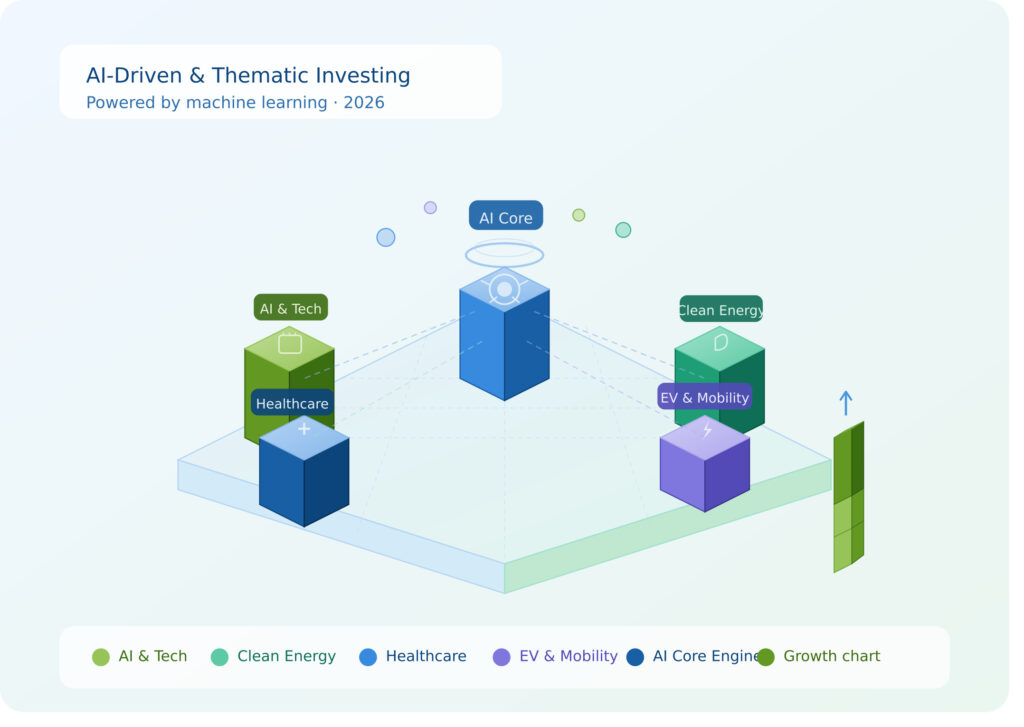
Based on current AI trend analysis and global macro signals, these are the five most compelling themes entering 2026:
1. Generative AI and AI Infrastructure The generative AI boom — driven by large language models and multimodal AI — is creating enormous demand for GPU chips, data centers, and cloud computing infrastructure. Companies like NVIDIA, Microsoft Azure, and Amazon Web Services sit at the epicenter of this theme.
2. Energy Transition and Clean Technology As governments worldwide accelerate their net-zero commitments, the clean energy transition is one of the most well-funded structural trends in history. Solar, wind, green hydrogen, and grid storage are all massive sub-themes within this space.
3. Longevity and Precision Medicine Advances in genomics, AI drug discovery, and personalized medicine are transforming healthcare from a reactive to a proactive industry. Companies leading in CRISPR gene editing, AI diagnostics, and anti-aging research are positioned for extraordinary long-term growth.
4. Electric Mobility and Smart Infrastructure Global EV adoption is accelerating, but the real opportunity extends beyond the cars themselves — into EV charging networks, vehicle software, autonomous driving systems, and smart traffic management.
5. Cybersecurity and Digital Privacy As AI itself becomes a weapon for cybercriminals, the global cybersecurity market is projected to exceed $500 billion annually by 2030. This theme is highly defensive and tends to perform well even in economic downturns, because companies simply cannot afford to cut their cybersecurity budgets.
How Beginners Can Start with AI-Driven Thematic Investing
You do not need to be a tech wizard or a finance professional to get started. Here is a practical roadmap:
Step-by-Step Guide for Beginners
Step 1: Educate Yourself on the Themes You Believe In Pick 2–3 structural trends you genuinely understand and believe will be important over the next decade. Do not just chase performance — invest in themes you can explain to someone else.
Step 2: Choose the Right Platform Consider beginner-friendly platforms like:
- Betterment or Wealthfront for robo-advisor managed portfolios
- M1 Finance for building custom thematic “pies” with ETFs
- Motif Investing, Titan, or Endowus for curated thematic portfolios
Step 3: Select Your Thematic ETFs Use the theme list above and research the corresponding ETFs. Check the expense ratio (aim for under 0.75%), look at the top holdings to make sure they align with your theme, and review 3–5 year performance history.
Step 4: Diversify Across Multiple Themes Never put all your money into a single theme. A balanced thematic portfolio might allocate across 3–5 themes, plus a core holding in a broad index fund for stability.
Step 5: Set, Monitor, and Rebalance Annually One of the great advantages of AI-powered robo-advisors is that they handle rebalancing automatically. But even if you are managing manually, an annual review to ensure your allocations match your intended theme weights is all you need.
Step 6: Stay Invested and Be Patient The single biggest mistake thematic investors make is selling during a drawdown. Structural trends do not play out in a straight line — they experience volatility. The investors who stay the course through the tough periods are the ones who capture the full upside.
Pro Tip: Dollar-cost averaging (investing a fixed amount every month regardless of market conditions) is a highly effective strategy for thematic investing, particularly in high-volatility themes like AI and clean energy.
Frequently Asked Questions (FAQs)
Q: Is AI-driven investing safe for beginners? A: Yes, especially through robo-advisors and thematic ETFs. These tools are designed to be accessible, diversified, and affordable. Just make sure you understand the themes you are investing in and maintain a long-term perspective.
Q: What is the minimum amount needed to start thematic investing? A: Many platforms allow you to start with as little as $1 (fractional shares). Realistically, $500–$1,000 is enough to build a meaningful thematic portfolio across 3–5 ETFs.
Q: Can AI predict the stock market? A: No — and be skeptical of any platform that claims otherwise. AI dramatically improves the probability of making better decisions, but markets are inherently uncertain and no system can predict them perfectly.
Q: Are thematic ETFs better than index funds? A: They serve different purposes. Index funds offer broad, low-cost market exposure. Thematic ETFs offer concentrated exposure to specific trends with higher potential returns — and higher risk. Most advisors recommend using both.
Q: What is the difference between thematic investing and sector investing? A: Sector investing follows traditional industry classifications (e.g., “Technology” or “Healthcare” sectors). Thematic investing cuts across sectors based on structural trends — a “Clean Energy” theme, for example, might include companies from the utilities, technology, materials, and industrial sectors simultaneously.
External Resources for Financial Learning
For official information about financial planning and investor awareness, you can explore:
Do Follow External Links:
These organizations provide reliable financial education resources.
Related Articles
- How to Start Investing with ₹5,000 in India (Beginner Guide)
- How to Create a Simple Investment Plan for Long-Term Wealth
- What Is Compounding? How It Builds Long-Term Wealth (With Examples)
Final Thoughts
AI-driven investing and thematic investing represent two of the most exciting developments in modern finance. Together, they give investors of every level — from beginners to seasoned professionals — the ability to align their portfolios with the most powerful structural trends shaping our world, backed by the analytical power of artificial intelligence.
The old approach of picking random stocks or passively accepting whatever a traditional fund manager decided is giving way to something smarter, faster, and more democratized. AI does not guarantee profits, and thematic investing carries real risks that every investor must understand. But for those who take the time to learn, choose wisely, and invest with patience — the opportunity is genuinely exciting.
The future of investing is not just about money. It is about backing the ideas and innovations that will define the next generation. And with AI in your corner, you have never had a better research partner to help you do it.